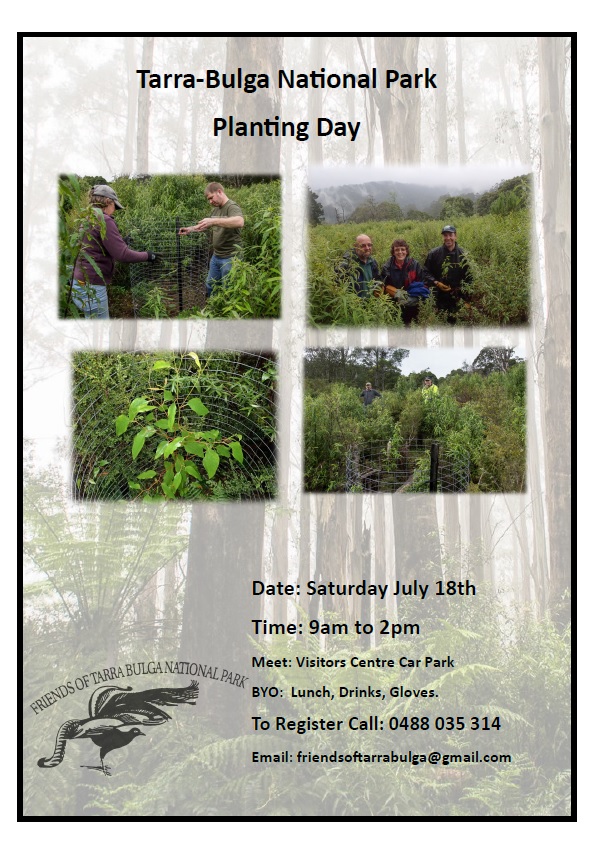
Friends of Tarra-Bulga are looking for volunteers to assist with a planting day on Saturday July the 18th. This will be the third planting we have undertaken at this site along Diaper Track and we are really starting to see some fantastic results. It would be a great opportunity for past volunteers to come along and view the progress being made, but anyone interested in helping restore a towering Mt Ash forest is encouraged to come along.
The meeting point will be at the park visitors centre at 9.00am.
We always cross our fingers and hope for favourable conditions on the morning of our annual Lyrebird Survey which this year was held on Saturday May 30th. This year there was no rain but unfortunately the wind was up and noisy gusts were swirling through the canopy.
The logistics of getting a large crew of volunteers up and ready to participate at 6.15am means that we can’t afford to be flexible with our dates so it is a matter of carry on regardless. This year we had 22 volunteers turn up for the count, with most people pairing up, we were able to cover 12 out of our 16 monitoring stations, as is often the case the 4 stations in the southern section of our count area were left out.
Volunteers did a great job of arriving by 6.15 and by the time instructions were given and stations allocated it was still a rush to get into position. I found that the sun was rising and some birds had started calling a few minutes before I made it to my monitoring point at 6.55am.
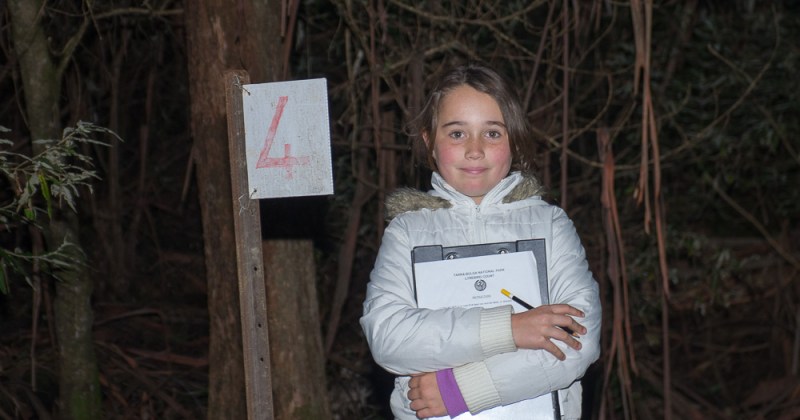
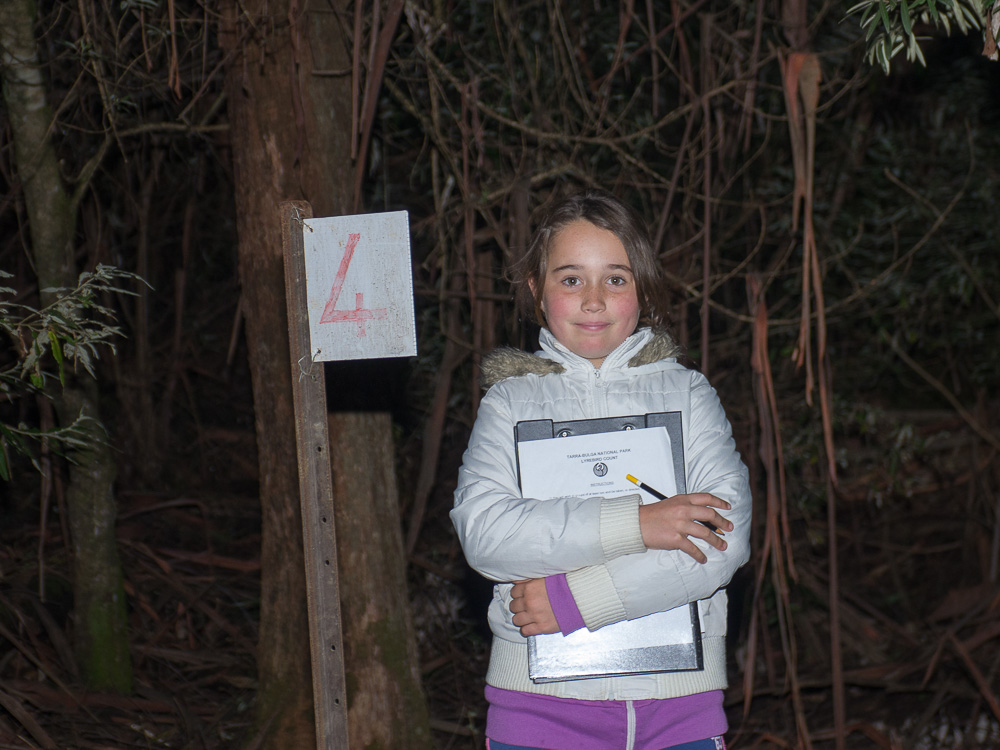
Monitoring Station #4
The next ½ hour was spent listening out for birds, at our site we could hear calling from three directions and once bearings were taken and noted we just settled in and enjoyed the surrounds. I noted some noisy Yellow-tailed Black Cockatoos moving in the canopy overhead as well as the odd loud crack from randomly scattered Eastern Whipbirds may potentially cause confusion for novice counters. Once our time was up we headed back along the track and soon came across a live sighting of a female Lyrebird (or perhaps a juvenile male?) wandering along the path.
Back at the guest house we once again had a great breakfast (thanks to Torben and Pam). After all the monitoring sheets were handed in it was time to analyse the results. The number of birds detected this year was down, although hopefully this is not cause for alarm; the survey relies on hearing the calls and the background noise of the wind makes them more difficult to detect. We definitely had 4 male birds calling in the survey area with one other likely one. Instances where it was noted that birds were calling very close to monitoring stations, helped to identify some of the Lyrebird locations with certainty.
A big thank you to everyone who made the effort to drag themselves out of bed so early and travel up to Balook to help out, your efforts to help conduct our annual surveys and monitor the local Lyrebird population is very much appreciated. Also thank you to our Ranger Craig who does a fantastic job setting up the monitoring stations and organising the troops. At the start of the count Craig pointed out that this was our 20th Annual Lyrebird Survey and that he had attended every one. Next year will be a big one (our 21st).
Clink on the link for a pdf map of the survey results.
Our annual Lyrebird survey is coming up on Saturday May 30th. The meeting place is at the Tarra Bulga National Park Visitors Centre at 6.15 am. On arrival the recording process is explained and people are allocated to various monitoring points around the Bulga Park area.
The survey begins at sunrise with the first Lyrebird calls and only takes around half an hour. Following the morning chorus, a free cooked breakfast is on offer at the Tarra-Bulga Guest House. If you would like to come along you need to contact us (by Wednesday May the 27th on 0488 035 314 or email friendsoftarrabulga@gmail.com. Wear warm clothing, a parka, bring a watch, a torch and compass (optional).
Weekends are busy times with lots of important stuff to do like shopping, housework, playing/watching sport, sleeping in etc, but why not put all that on hold tomorrow and join us at our working bee.
The Friends of Tarra-Bulga National Park are seeking volunteers on Saturday April 18th to help with some weeding and preparation for an upcoming planting day.
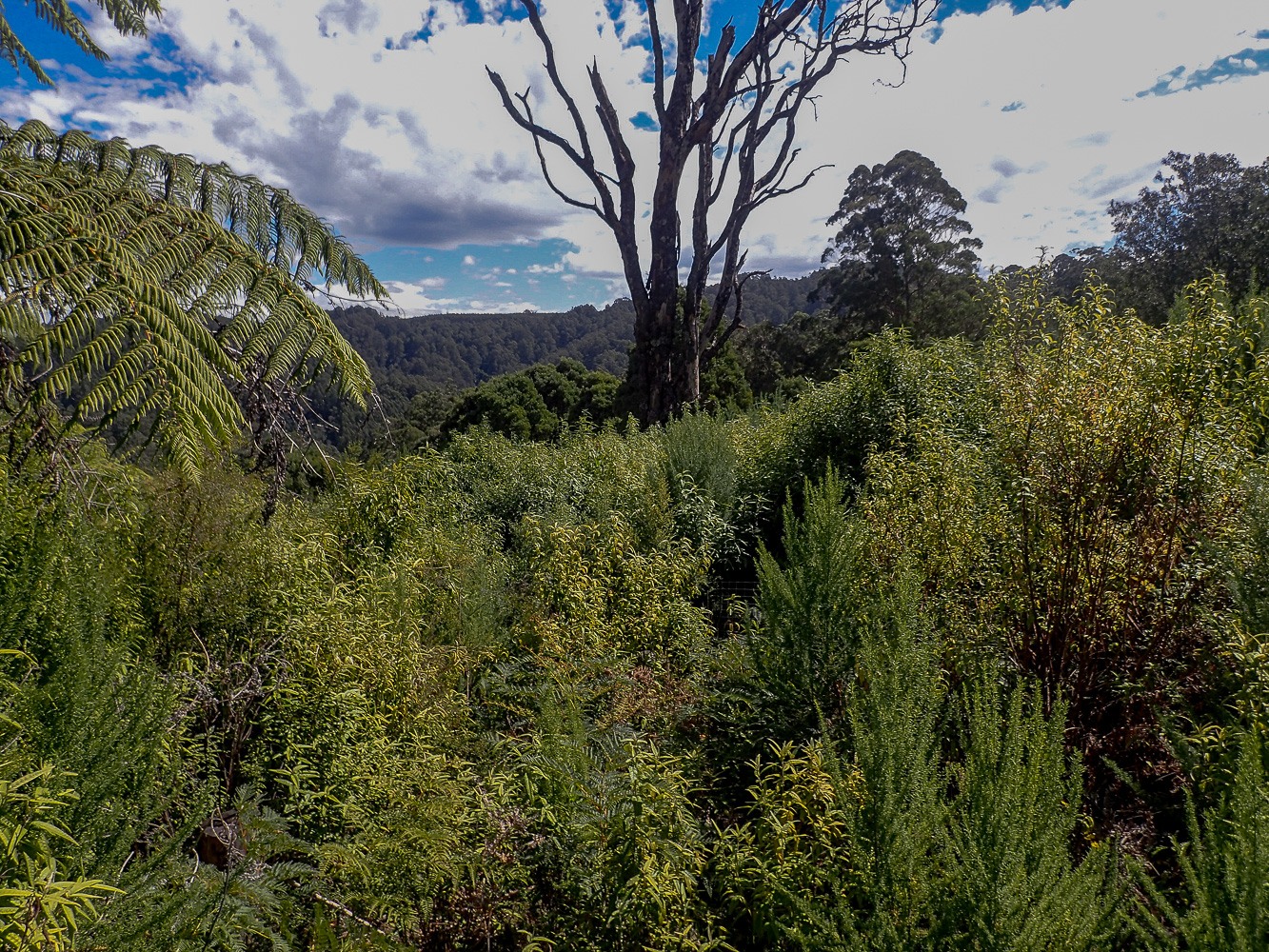
The worksite is along Diaper Tk and getting there will involve a scenic 3km walk. The work involves rehabilitating a site where a major infestation of Sycamore Maple was discovered several years ago. The site is quite overgrown with re-growth scrub and as well as looking for weeds to pull we will be clearing new tracks to allow easier access for a tree planting planned in July.
The meeting point is at the park visitors’ centre at 9am. You will need to take a cut lunch and your own drink. For further details phone David on 0488 035 314 or email friendsoftarrabulga@gmail.com
Come and help us turn this scenic but scrubby site back into towering Mountain Ash Forest
Our first group activity for the year will be held at a site in the park along Tarra Valley Rd that we have been working on for nearly a decade now. Initially we started tackling a serious infestation of Sycamore Maple, which is a tree that can be very invasive, it has light papery seeds that disperse in the wind, it can grow in shade and then potentially become a large tree. Over the years we have pulled out hundreds of new seedlings that have spread into the park and cut out and killed many larger saplings.
Tutsan with some fruit ready to spread more seed into the park.
We have now been successful at getting the Maple fairly well controlled and we have now also started on another weed (Tutsan) that is established at the site. Tutsan (Hypericum androsaemum) is a perennial shrub that grows to about 1.5m tall, it is related to St John’s Wort and is noted as being a serious threat to damp and wet schlerophyll forests. We have received a Communities for Nature grant to assist our efforts that will be used to fund contractors to spray the larger infestations as well as to purchase some hand tools and chemical to support our efforts.
We will be holding a working bee at the site on Saturday March the 21st. The meeting point will be at the Tarra Valley Car Park at 9.30am. Like many of our working bees’ the terrain will be steep and lots of scrambling through undergrowth will be required. Tools will be available but if you have your own favourite gloves or loppers please bring them along. Following the work we will have a free BBQ lunch provided down at the Fernholme Caravan Park (at around 1pm). If you are able to come along please call or email David Akers (0488 035 314) or friendsoftarrabulga@gmail.com preferably by March the 18th so we know how much food to buy.
Grazing Swamp Wallabies are a huge hurdle to successfully growing new trees in sections of Tarra-Bulga National Park. Hard lessons have been learnt, 1000’s of trees have been planted, but experience has shown that even if they are hidden or planted among unpalatable species the Wallabies will eventually find them and eat them. Regular tree-guards have proven to be of little use, they may protect the plant for a short while but Wallabies will chew any growth at the top of the guards that they can reach, the plant will remain stunted and eventually die. A commercially available Wallaby repellent mixture can be sprayed on new growth to protect it, but that is labor intensive and requires regular follow up to have any chance of success, not a viable task in our situation with limited time and rough terrain to encounter . The only strategy that does seem to work for us is to use large wire mesh tree-guards which are expensive and very labor intensive to install and eventually remove once the trees have grown big enough..
Why do we think direct seeding might be a solution? Nursery grown tube-stock are generally grown in ideal conditions, with fertiliser, controlled sunlight and regular watering, as a result the leaves are highly palatable. Plants that germinate from seed on sites should be tougher, slower growing and as a result have less tasty foliage. Mountain Ash along with other species of Eucalyptus seeds are very small, one gram of Mountain Ash seed contains nearly 200 viable seeds. For our trial we have 390 grams of Mt Ash seed, if all of them germinate we would have almost 80,000 seedlings scattered over the site. That is clearly an optimistic outcome but hopefully we can get a good germination strike rate and some of those tiny little seedlings can overcome the Wallabies and other forces of nature to successfully grow into mature trees. We will keep you posted.
Mountain Hickory Wattle, seed should still be good even though it is 8 years old.
Mountain Ash (Eucalyptus regnans seed) potentially 78,000 trees in this bag.
The Green Walks in the Park program is sponsored by the Heart Foundation and every month there is a guided walk held at Tarra-Bulga National Park. The walks are a great way to explore the park as well as learn more about Tarra-Bulga from members of the Friends group or a Park Ranger along the way. The next two walks will be held on Tuesday November the 4th (Cup Day) and Monday December 1st. Both departing from the visitors centre carpark at 10am. To register contact Bonnie, Local Coordinator Heart Foundation Walking on 1800 242 696 further details here Green Walks Nov and Dec 2014




 Friends of Tarra-Bulga National Park