Winter

When is the best time of year to visit Tarra-Bulga? I would argue any time of year could be the answer as each season tends to bring its own particular highlights.

In spring you have lots of fresh new growth and it is the peak time to catch most things in flower. In summer the shady rainforest gullies are an ideal retreat from the heat. In autumn, the diversity of fungi adds to the experience. In winter, everything is lush and green. After rain, cascading mini waterfalls in unexpected places can add to the spectacle. It is also the time when Lyrebirds are putting on displays.


Lyrebird Survey Results 2014

Perfect conditions this year for our annual Lyrebird count, with a beautiful still and mild morning. Another bonus was thirty keen volunteers fronting up for the 6.15 am, which meant we could cover all our 16 monitoring points. Thank you so much everyone for turning up, with many coming from far and wide to participate.

From our mapping we identified at least 10 male birds calling, which in memory is one of our best results. At several stations tracing birds was easy because they were observed calling from trees directly overhead the post. The folk monitoring the Bulga Car Park also reported a male and female (or juvenile male) bird running through their site.

It was hard for many of us to drag ourselves away from the calling birds and across to the guest house for breakfast. The last group back had been lucky enough toc come across a male in full display next to his mound. It wasn’t  only Lyrebirds that were vocal on such a nice morning with Whip Birds, Tree Creepers Kookaburras and others adding to the morning chorus.

lyrebird count 2014
lyrebird count 2014


See What When – Remote Camera Hourly Analysis

A recent post reporting on the results of our camera trap monitoring program for 2013, identified a trend with Swamp Wallabies where numbers photographed by across the park by camera traps dropped very sharply after July.  We have no real explanation for this, but as we gather further data, it will be interested to see large annual fluctuations in the Wallaby count continues.

We had an inquiry as to whether it was more common to record Swamp Wallabies in daylight or during the night-time, which is an interesting question and one which is easy to work out from our database. So after crunching some numbers here are some answers, not just for Swamp Wallabies, but for all our commonly recorded species.

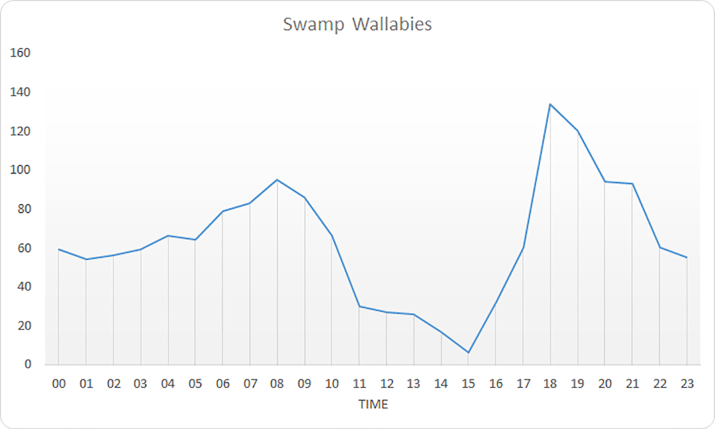
Swamp Wallabies
Swamp Wallabies

Swamp Wallaby triggers are fairly regular at any time of day or night, they do seem to slow down as you might predict in the middle of the day, but then fire up to have their peak numbers in the early evening.

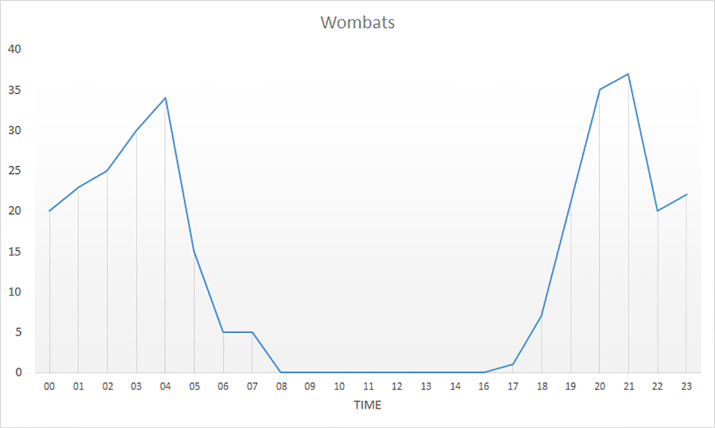
Wombats
Wombats

Although it is not particularly uncommon to see Wombats out during the day sometimes, perhaps surprisingly we have never had one trigger a camera between 8am to 4pm. They seem to have peak activity in the evening and another peak around 4am.

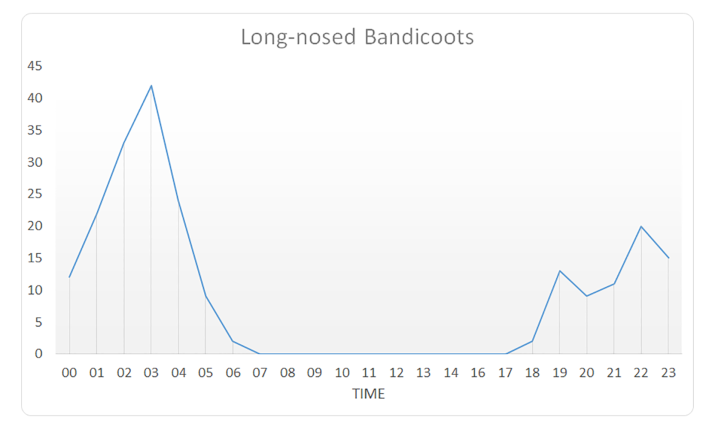
Long-nosed Bandicoots
Long-nosed Bandicoots

It’s no surprise that these Bandicoots are rarely seen, although we get fairly regular photos of them, they seem to have a definite peak of activity between 2am and 4am.

Foxes
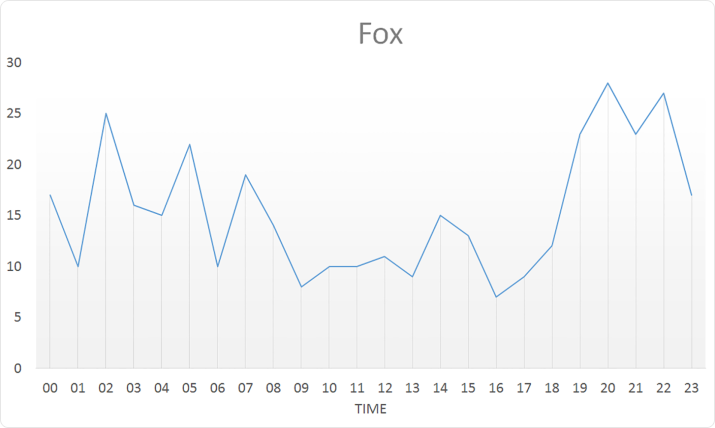
FoxesThe graph shows here that there is never any time of day for animals to be complacent. Foxes can be active at any time of day, seems like they are marginally more common at night. Also have data on Feral Cats, they too can be around at all hours, but seem less likely than a Fox to be around in daylight.

Lyrebirds
Lyrebirds

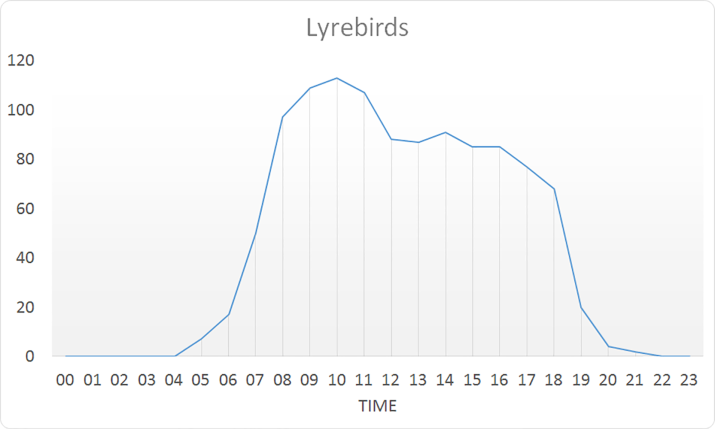
Lyrebirds in Tarra-Bulga obviously need to make the most of the daylight hours. It seems there is a slightly greater chance they will be snapped by a camera in the morning, but overall any time of the day is good for them.


 Related Posts:

2013 Remote Camera Stats

Camera Site Greatly Exceeds Expectations

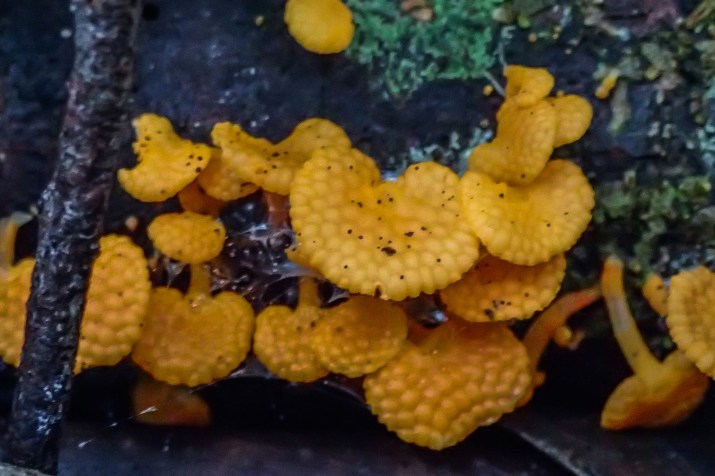
Orange Pore Fungi - Favolaschia calocera

Alien Fungi

Seems like not only plants and animals can be invasive. Yesterday, while walking along Forest Track, I spotted an unusual Fungi fruiting on a fallen log. It was a vivid orange colour and seemed to have an unusual pore arrangement on the underside. After snapping a few photos, I headed home to consult the field guides. Seeing nothing really to match, I uploaded the photo to http://www.Bowerbird.org.au  where a subscriber there quickly identified it as an exotic species, Favolaschia calocera otherwise known as Orange Pore Fungi.

Orange Pore Fungi - Favolaschia calocera, underside showing the pores.
Orange Pore Fungi – Favolaschia calocera

This Fungi apparently is a recent arrival to Australia the first record of it is from 2005. It was first observed in Madagascar and has recently spread to a number of countries across the globe. According to Wikipedia it colonises ruderal sites (Wastelands/Roadsides) where it can become the dominate species. Fingers crossed it does not become a dominate feature of our not so ruderal forests. Not sure how you can weed out or control a pest fungi.

Orange Pore Fungi - Favolaschia calocera
Orange Pore Fungi – Favolaschia calocera, View from the top showing the caps.


2014 Lyrebird Survey

One of our most popular volunteer activities is coming up on Saturday May 31st. The survey, which monitors trends in the Lyrebird population involves an early start. The meeting place is at the Tarra Bulga National Park Visitors Centre at 6.15 am. On arrival the recording process is explained and people are allocated to various monitoring points around the Bulga Park area.

The survey begins at sunrise with the first Lyrebird calls and only takes half an hour. Following the morning chorus, a free cooked breakfast is on offer at the Tarra-Bulga Guest House. If you would like to come along you need to contact ranger Craig Campbell (by Wednesday May the 28th on 5172 2508 or email craig.campbell@parks.vic.gov.au. Wear warm clothing, a parka, bring a watch, a torch and compass (optional).

A couple of birds from our Remote Camera monitoring.

2013 Remote Camera Stats

Here’s a breakdown for you all showing the species that triggered our remote cameras last year. The lower number of detection in the later part of the year can be explained by a few issues that we had with dodgy SD cards causing the batteries to conk out prematurely. Can’t explain why the Wallaby numbers vary so much each month. Some of the other species e.g. Lyrebirds, seem much more evenly represented over the year.

Breakdown of Remote Camera
Triggers – Tarra Bulga National Park 2013

Species

Total

Jan

Feb

Mar

Apr

May

Jun

Jul

Aug

Sep

Oct

Nov

Dec

Swamp Wallaby

978

50

44

105

139

164

186

157

28

14

28

15

48

Superb Lyrebird

679

48

46

59

86

70

73

50

72

54

61

38

22

Fox

256

16

22

20

49

39

30

28

20

8

10

10

4

Brushtail Possum

190

12

8

27

33

20

13

20

9

4

11

15

18

Wombat

175

3

12

14

22

33

13

24

10

4

7

26

7

Rat

170

16

2

4

12

7

15

17

27

54

12

4

Bassian Thrush

156

8

11

22

24

4

10

12

20

5

9

4

27

Unidentified Bird

115

6

8

20

12

20

6

3

4

5

15

10

6

Long Nosed Bandicoot

95

9

6

8

13

8

9

5

10

19

4

1

3

Antechinus

84

3

9

8

16

12

5

12

6

2

5

5

1

Small Mammal – Unidentified

76

5

2

2

5

14

6

13

14

5

4

4

2

Ring-tailed Possum

61

1

2

2

2

5

6

18

18

7

White-browed Scrubwren

53

3

1

2

10

6

7

6

2

2

3

8

3

Rabbit

46

1

5

3

2

6

4

4

3

18

Pilotbird

40

4

17

5

1

2

8

1

1

1

Feral Cat

39

3

1

10

7

3

3

4

5

1

1

1

Short-beaked Echidna

19

1

2

2

7

3

1

3

Large Mammal – Unidentified

19

1

4

7

1

2

4

Brush Bronzewing

17

1

2

1

1

3

1

4

1

3

Eastern Whipbird

15

1

1

3

1

3

1

1

1

2

1

Grey Currawong

13

1

8

1

1

1

1

Common Blackbird

12

2

1

9

Koala

11

1

5

2

1

1

1

Olive Whistler

11

1

2

8

Kookaburra

7

4

1

1

1

Crimson Rosella

5

1

4

Superb Fairy-wren

4

1

1

1

1

Satin Bowerbird

4

1

1

1

1

Pied Currawong

4

1

3

Grey Shrike-Thrush

3

2

1

Eastern Yellow Robin

3

1

1

1

Sugar Glider

3

2

1

Fantail, Grey

2

1

1

Fantail, Rufous

2

2

Common Bronzewing

1

1

Raven Species

1

1

Brown Thornbill

1

1

Mystery Species

1

1

Dog

1

1


Fungi Time and Sycamore Maples

We had our annual “Maple Pull” at a site along the Tarra Valley Rd yesterday. The fact that we had only a small crew turnout was OK because thanks to our consistent efforts we have got to the point where the task is mainly a search mission, when we first started out we were pulling hundreds of seedlings. Yesterday after tramping around the area we managed to find and either hand pull or cut and paint forty seven young Sycamore Maple, as well as prising out some Blackberry seedlings and the odd stray bit of Ivy. The Maple is being controlled, but we still have issues with Tutsan at this site, and that will be a future war, that we may one day have the energy to take on but it will be much harder to win.

While wandering around in search of Maple it was a good chance marvel at the fresh new Fungi blooms. They are a real feature at this time of the year and thanks to consistent rain to date in Autumn, it should be a bumper season for Fungi spotters. After the work, we looked after the workers (a tradition at Friends of Tarra-Bulga) and headed down to the Fernholme Caravan Park where David provided us with toasties, hot coffee and freshly baked banana cake. We were joined at the table by a Lewin’s Honeyeater. A great way to refresh after spending the morning out in the dripping wet forest.

Related Posts