Very informative video here from PestSmart, where they give an excellent lesson on remote cameras (like the ones our group uses in Tarra Bulga) and how to get the best results out of them when using them for monitoring wildlife and pest species.
Friends of Tarra-Bulga National Park
Website of the Friends Group – Information about working bees and monitoring projects. As well as flora and fauna pictures and descriptions

Very informative video here from PestSmart, where they give an excellent lesson on remote cameras (like the ones our group uses in Tarra Bulga) and how to get the best results out of them when using them for monitoring wildlife and pest species.
After some very windy and cold weather at the end of winter including the snow of only a week and a half ago, the last day of winter was almost perfect. The first day of Spring tomorrow also promises to be just as good. Calm winds and blue skies made today a gem of a day to be at Tarra Bulga. Birds were all around, and spring flowers were starting to bloom. The Silver Wattles were bright yellow and sections of the walking tracks were covered in fallen Sassafras flowers. A Male Lyrebird landing on a tree just above my head was a breathtaking moment on such an ideal day to be in such a magnificent place.








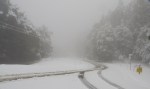
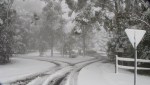
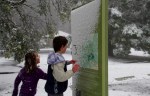
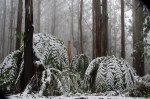
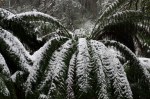
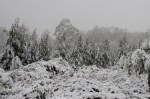
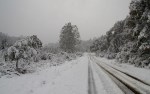
Heavy snowfalls are a relatively rare event at Tarra Bulga National Park. A large dump in August 2005 caused a lot of damage to the park’s vegetation due to the weight of the snow. Today’s snow is the biggest dump since this event and hopefully the damage will not be too severe but it certainly will have an impact.
This morning there were plenty of tree branches cracking under the weight of the snow and in more open areas shrubs were taking a battering. Tree Ferns are an ideal shape to catch snow on their fronds, but thankfully they seem very good at recovering from damage. The area where our working bee was a week and a half ago was covered in snow, which is not an ideal start for our newly planted Mountain Ash seedlings.
It was interesting to see the Fauna’s reaction to the sudden icy change to their landscape with a confused Kangaroo hopping about (outside the park boundary) and Lyrebirds and other species buzzing around and looking a bit agitated. The snow would have affected mainly the higher elevations in the park, with sites along the Grand Ridge Rd catching the heaviest falls.






The planting activity this month saw a good turnout of members of both our group as well as some great helpers from the Conservation Volunteers. The work focused on adding overstorey species (in this case Mountain Ash) to a scrubby regrowth site located along the Grand Ridge Rd.
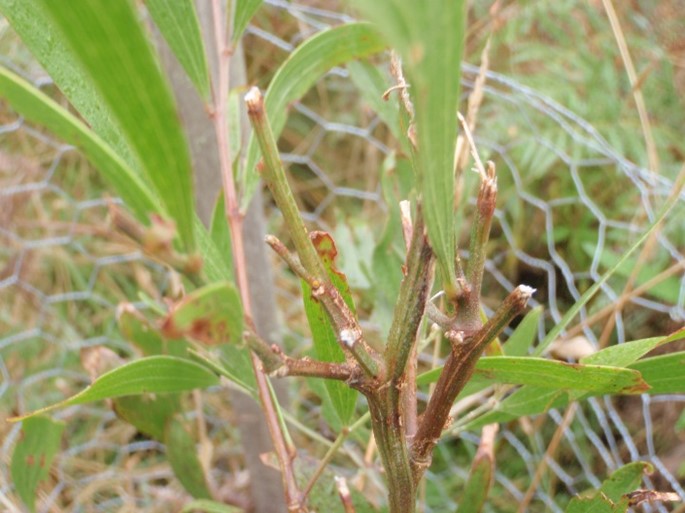
Several years ago we had planted Blackwood’s on this site with mixed success. Blackwood seedlings are a favourite food of Wallabies. We found that the Chicken wire guards we used back then were not 100% successful in keeping Swamp Wallabies at bay and that they were able to reach the top and nibble the new growth. An application of Sentree (Wallaby Deterrent) helped to give the plants a fighting chance, but most are still quite stunted where as the ones that have got away have reached over 3m tall. Hopefully the new improved guards we used today; which were taller, wider and made of stronger mesh; will see a better success rate. They will also be able to be reused down the track for future plantings. Some of the dead Blackwoods had reached several feet high and then died. They had no roots left, so not sure whether they had been chewed off (by rats??) or maybe caused by the tubes being root bound or just rotting away, the stems were still quite green.
All up we planted 40 new Mountain Ash trees, as well as removing old guards from previously planted trees. Although this may not be a big number, it is a reflection on the careful effort we made to do the job properly and make sure they are well protected, so hopefully, they get the chance to grow into forest giants. Thanks to Pam and David for preparing a delicious barbecue lunch for the starving workers, and also to the Conservation Volunteers for their tremendous support for this event which was an enjoyable and productive day.
We had our Annual Dinner for the Friends of Tarra Bulga last night and these videos were shown as a summary of the results from our remote cameras for the year. They are now up on YouTube and can be seen here for anyone who was unable to attend and anybody else that is interested.
This second video is from one camera from the Tarra Valley section of the park that was in place for almost a whole year. It has some of the animals labelled to help you know what you are looking at.
Friends of Tarra Bulga National Park
Volunteers Wanted
Working Bee: Saturday August 10th
Time: from 10am until Lunchtime.
Task: We will be meeting at the visitors centre and then moving on to a planting site that the group has been rehabilitating. The aim is to plant some new Mountain Ash seedlings as well as to do some maintenance on previous plantings including the removal and re-use of wire mesh guards.
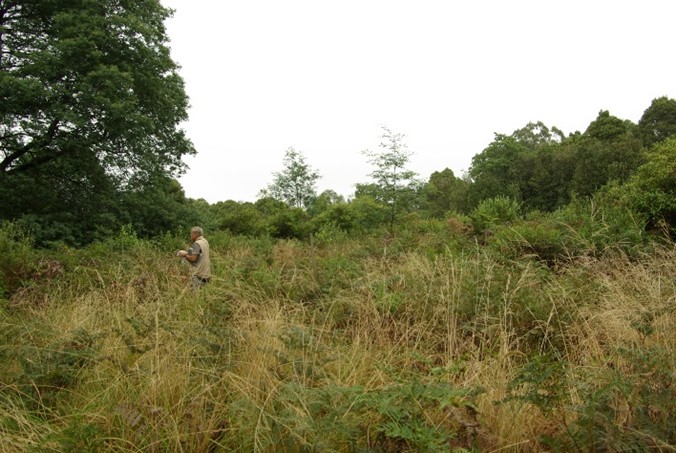
This is the site we are trying to turn back in to tall Wet Forest
Wear/Bring: Boots or Gumboots, Gloves.
Afterwards: Lunchtime bbq provided for the workers.

Register: David Akers on 0488 035 314 or email dakers@activ8.net.au by Wednesday August the 7th.
Asplenium’s or Spleenworts are a very interesting group of ferns and at Tarra Bulga there are three species that can be found. One of them is common in Rainforest gullies while the other two are harder to find. It is not hard to tell each one apart although there may me some hybridisation happening between two of the species which can be confusing.
Mother Spleenwort – Asplenium bulbiferum subsp. gracillimum
This is common in the park mainly in rain forest gullies, it grows as epiphytes on tree and fern trunks as well as on shady banks, and among rocks. It can be potentially confused with other ferns that grow in this habitat such Shiny or Leathery Shield-fern. An impressive feature of this fern is its ability to reproduce via bulbils that can form on the tips of the fronds, giving rise to its common name “mother” as well as the Latin one. A good way to distinguish it from other ferns is to locate the linear to oblong shaped sori on the margins of the underside of the fertile fronds and to look for the many tiny brown scales on the surface of the stem and the fronds.
Weeping Spleenwort – Asplenium flaccidum subsp. flaccidum
Weeping Spleenwort is very uncommon in the Park, hopefully there is more hidden away in some gully that we don’t know about, but we only really know about one living plant that currently exists here. Compared to Mother Spleenwort it has linear to oblong pinnules that are not lobed. The pinnules are widely spaced on the long Weeping Fronds. It only has a few scattered scales.
Necklace Fern – Asplenium flabellifolium
Necklace fern is unlikely to be found in the Cool Temperate Rainforest areas in Tarra Bulga, it is more often in sheltered shady spots (e.g.) along road cuttings in more exposed sections of the park. It is more common at lower altitudes in the district, e.g. in the Warm Temperate Rainforest of Macks Creek. It is easily distinguished from the other local Asplenium species with its small slender green fronds having fan shaped leaflets (pinnae), forming what could be described as a necklace.
Possible Hybrid???
According to some sources Aspleniums are known to hybridise across species. Several plants that I photographed along the Fern Gully Track at Bulga Park, seem to have features somewhere intermediate between Mother Spleenwort (Asplenium bulbiferum) and Weeping Spleenwort (Asplenium flaccidium).
 Friends of Tarra-Bulga National Park