To all of those people who did the Lyrebird Survey this map can give an indication of what was going on this year.Geographic Information System (GIS) software was used to plot the location of all of the monitoring sites. Then the lines coming out from each site were drawn using the information that all the volunteers recorded during the survey. Once all the lines have been drawn we can then find points where several lines from different monitoring points intersect. At these points we can be confident that there was a Male Lyrebird calling during the survey period.
We were happy to have perfect weather for Lyrebird Counting, still calm conditions meant that Lyrebird calls would be easy to detect. We had an excellent turnout with 32 helpers including a contingent of Scouts. Ranger Craig briefed the early morning crowd about their roles and passed on his knowledge in terms of taking a compass bearing. We then raced out to our monitoring points, in order to be in position before the first birds began calling at the break of dawn. After only a quarter of an hour or so all groups recorded several different birds calling and there were a number of live sightings. It was then (as is the custom) time to migrate to the guesthouse for a hearty breakfast. After all the recordings were logged and mapped we can confirm at least 6 birds were present in the target area, which thankfully shows that the Parks Lyrebird populations are still going strong.
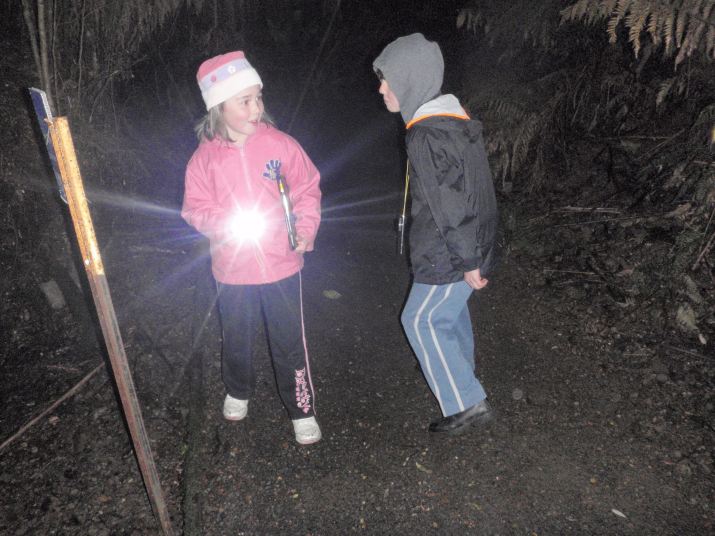
Everyone paying attention to the instructions before going out to their positions.Two young helpers ready to start the Lyrebird SurveyLyrebird Surveyors Breakfast
It’s on again. The Friends of Tarra Bulga are looking for interested volunteers to participate in our Annual Lyrebird Survey on Saturday June the 2nd. It involves an early start, people need to be at the Tarra Bulga National Park at 6am so we can get organised to get to our monitoring positions before sunrise. The survey itself only takes half an hour and after that a cooked breakfast is on the menu. If you would like to come along you need to contact ranger Craig Campbell on 5172 2508 or email craig.campbell@parks.vic.gov.au. Wear warm clothing, bring a watch, a torch and a compass (if you have one).
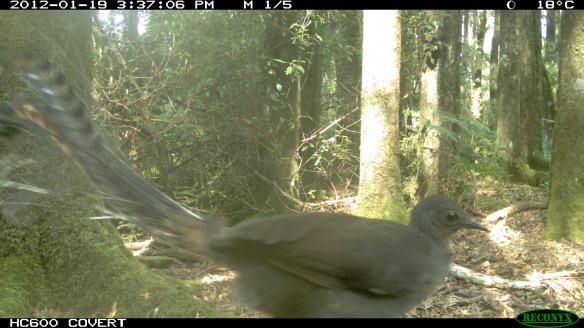
Superb Lyrebird – Menura novaehollandiae – All ready to be counted!
This little critter nearly went by unnoticed until we went back through some remote picks and spotted it here. It is an Agile Antechinus – Antechinus agilis. They mainly feed on invertebrates such as spiders and beetles. Like all antechinuses, the Agile Antechinus has a short and violent breeding season, after which the males all die.
You might have to look closely to find this little Antechinus
A very common site in the Strzelecki Ranges, the Common Wombat – (Vombatus ursinus) is mostly nocturnal and shelters in large burrows. The single young leave the pouch around 6-9 months of age and follow the mother on foot until they are fully weaned at about 20 months old. They only produce one young every 2 years. They feed on grasses, sedges and tubers. Be on the look out for them on the roads at night, They have absolutely no road sense and are likely to run straight in front of your vehicle if startled.
It was the first time we had done one for a while, but it went very well so we are certainly going to do some more (Guided walks that is). On a damp Saturday October 29th a group of close to 30 walkers fronted up for the first Friends of Tarra Bulga walking activity for many years. The Boondarra walking group coincidentally had a posse of walkers planning to do the same walk that day so they were invited to join us which was one contributor to the healthy numbers.
It was apparent early on that the moist conditions were very suitable for small hitchhikers so regular stops were made as seen it the picture below, to stop and search and turf off any castaways.
First of many checks for passengers
We organised a car shuffle and the walk started from the Tarra Bulga Visitors Centre. One of the first sections you encounter is through a pine plantation which is a bit dull, but that soon gives way to some impressive forest.
Rare Burrowing Crayfish – One of several spotted on the walk
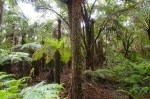
One early feature of the walk was the occurrence of several rare Burrowing Crayfish. As we got further into the walk towards the Tarra Valley section the large tree ferns became a feature with many epiphytic plants on their trunks as well as a range of impressive fungi species and the massive trees that are a feature of the park. The recent rainfall meant that gullies were flowing with water and it was a great opportunity to see some waterfalls cascading next to the track.
First of many checks for passengers
Boring Pine Plantation Bit
Open Ferny Area
Waterfall along Diaper Track
Diaper Track Scenery
Tree Fern
Plate Fungi on Trunk
Rare Burrowing Crayfish – One of several spotted on the walk









 Friends of Tarra-Bulga National Park