Hymenophyllum flabellatum - Shiny Filmy-fern

Filmy Ferns

Filmy Ferns are a feature of the wet gullies and rainforests in Tarra Bulga, they are usually found as epiphytes growing on the trunks of trees and other ferns, especially Soft tree-fern (Dicksonia antarctica) as well as rocks and steep embankments . There are five different species known to occur in the park and although they are small and delicate, with a bit of practice it is easy enough to learn to tell the difference between each species. Four of them belong to the same genus (Hymenophyllum). Along with the Filmy ferns there are many species of Mosses and Liverworts that flourish in similar moist sheltered locations.

Click on the Galleries for Closer Views and Photo Descriptions

Austral Filmy-fern  Hymenophyllum australe

This fern is dark green and not particularly shiny. It is common and easy to identify by the wing which is several millimetres wide and extends all the way along the central wiry stem from the tip of the frond to the base (stipe) where it is attached. It has lots of spore producing sori at the tips of the fronds. The sori have 2 lips and they often present in pairs.

Shiny Filmy-fern   Hymenophyllum flabellatum

This is another very common fern found in the rainforest gullies. As indicated by its common name it is very shiny and it is a lighter green than the Austral Filmy-fern. The stem (stipe) does not have a wing and has a tuft of hairs at the base. The pinnae (ends of the fronds) often form a fan shape. The sori (spore producing bits) at the tips of the frond segments are wider than the rest of the leaf.

Common Filmy-fernHymenophyllum cupressiforme

Common Filmy-fern is easily found and identified by serrated margins of its outer fronds. It has large spore producing sori which are located close to the main stem (rachis) of the frond. Alpine Filmy-fern (Hymenophyllum pelatum) also has serrated margins of it frond segments (pinnae) but it has never been found in the Tarra Bulga.

Narrow Filmy-fernHymenophyllum rarum

As its Latin name suggests this fern is the hardest to find of all the local species. It will often grow among Common – Filmy fern  (e.g. Along the East-West track in the Tarra Valley picnic area) and superficially looks similar. As its common name suggests it is narrow, It has a narrow wing along its main stem which may cause confusion with Austral Filmy-fern, but a clear distinguishing feature is the the V shape made by the veins at the base of the indusium (tissue protecting the spores) at the tips of fertile frond segments. Click on the Gallery below for a better view.

Veined Bristle-fern – Polyphlebium venosum

Is the only species of the 5 ferns not in the genus Hymenophyllum. It is very common in the same habitats as the other occur. It is distinguished by its very delicate pale green shiny fronds (only one cell thick). Tiny branched veins are clearly visible on the narrow fronds. The fertile fronds have a trumpet shaped spore cover (indusium).

Remote Camera Monitoring Autumn 2013

I have produced some stats to go with the latest update from our remote camera sites, hopefully it adds to the information we are getting from the monitoring sites.

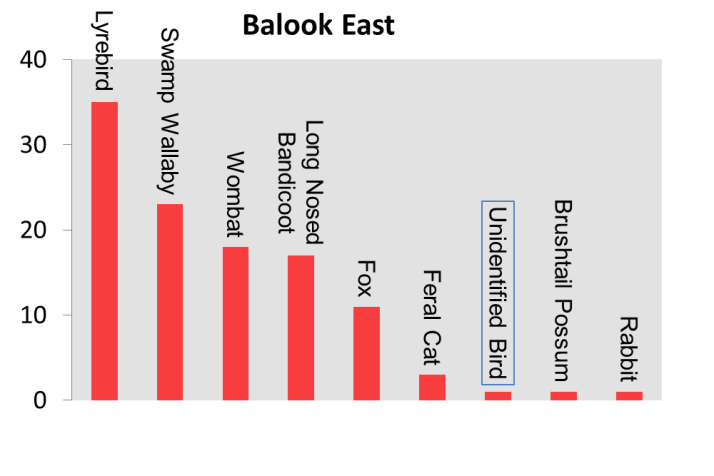
Camera 1 was but back in action after the Lyrebird attack a bit later than the others. It was placed around one of the original camera sites in a location I will call Balook Central. There was an alarming amount of Fox activity at this Camera, also no sign of Long-nosed Bandicoots which have been common at this site before (hopefully the 2 factors are not related). Note that in each graph when I am talking about Brushtail Possums it could be either the Common Brushtail or the Mountain (Bobuck) variety. I am not sure that it is possible to tell them apart from the remote camera photos.

Animal Visits - Graph
Animal Visits – Graph

This slideshow requires JavaScript.

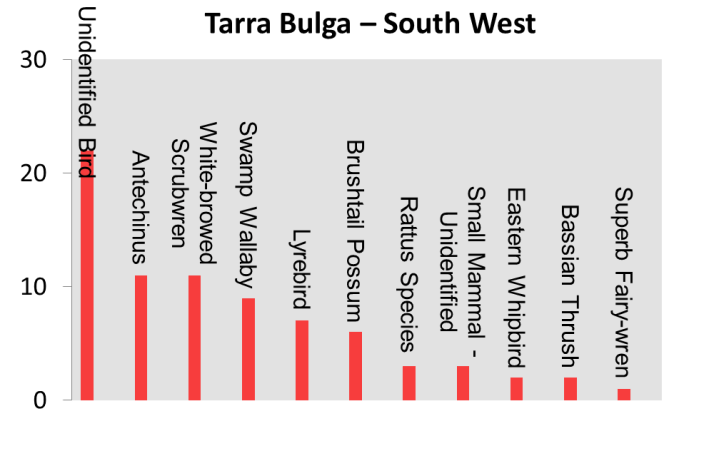
Camera 2 – Had a lot of bird activity, with lots of little brown birds that given their size, picture quality or the way they were facing, they were often hard to positively Identify. But there was certainly one or more active White-browed Scrub-wrens. The site was relatively quiet compared to past results. A tree branch falling in front of the Camera half-way through the monitoring period may have been a reason for this.  No sign of any Bandicoots but plenty of Antechinus and other Rodent species (probably Rattus fuscipes – Bush Rat ) but hard to identify just with the photos. Anthechinus have pointed snouts and their ears are thin with a notch in the middle. Rats have rounded ears. Sometimes it was impossible to tell whether it was an Antechinus or a Rat from the photos so in those instances, I have just called them unidentified small mammals.

Tarra Bulga South West - Animal Visits
Tarra Bulga South West – Animal Visits

This slideshow requires JavaScript.

Camera 3 – Had a lot of Small Mammal activity but not so many larger ones. Possibly due to the camera positioning and location. Lots of good shots an Antechinus Species (Could either be the Dusky Antechinus or the Agile Antechinus but impossible really to tell them apart from the photos. The Rattus species are probably Bush Rats, one way to tell is by their tail length, which in native rats is usually shorter than their body length. 

Tarra Bulga South Central

Monitoring Results for Tarra Bulga South Central site.

This slideshow requires JavaScript.

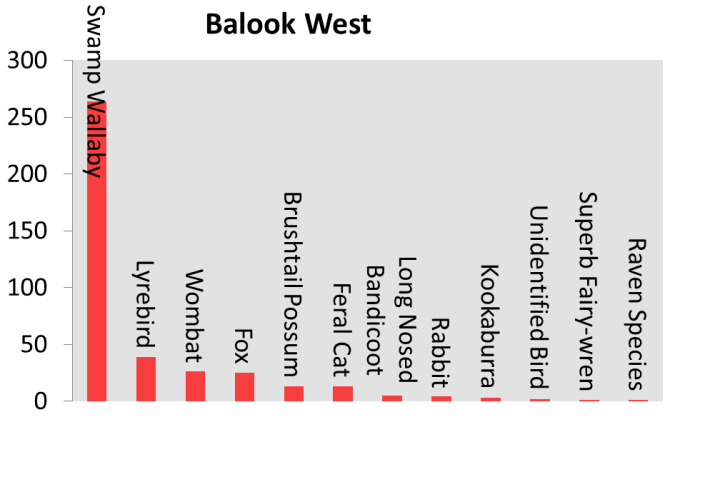
Camera 4 – I thought there must have been some sort of camera malfunction when I collected this camera from the field, there were over 9000 photos on the card. After looking through I found that the camera was working fine it was just an extremely busy site, especially for Swamp Wallabies, where as you can see by the graph they visited the site over 250 times over 2 months. Many times it was the same Joey with its family group which made for some cute photos with it bounding around. The site was in a fairly open clearing so it must have been a really favorite camping spot for them. In one situation a Swamp Wallaby was photographed while a Brushtailed Possum looked on from a tree trunk.  In addition to the Wallabies, we had Long Nosed Bandicoots and Lyrebirds. Look for the photo when a Lyrebird goes past and then a minute later a Fox is seen leaping through the air in the direction it went. Also look for the photos of the Fox with some prey in its mouth, I can’t tell what it is but it is about Bandicoot Size. Also a fair bit of Feral Cat activity at this site.

Remote Camera Species Count

This slideshow requires JavaScript.

Camera 5- This camera was obviously pointing at a favourite habitat for Bassian Thrushes, as they were the most common species here. They are often hard to spot in the photos as they are well camouflaged.

Balook Gully
Balook Gully – Remote Camera Species Count

This slideshow requires JavaScript.

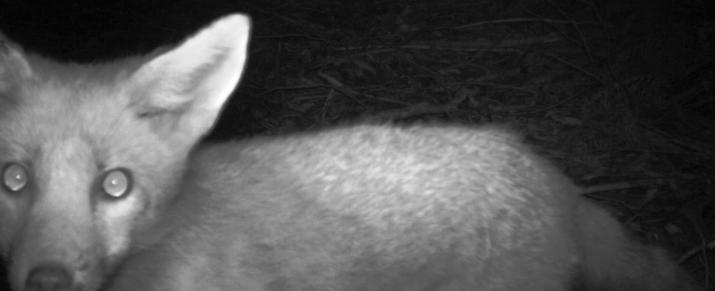
Camera 6- This site is on a ridge amongst large Tree-ferns, with a thick leaf litter. It has lots of Lyrebirds scratching around and plenty of Foxes prowling around.

Tarra Bulga North West
Tarra Bulga North West Remote Camera Species Count.
Fox
Fox

Camera 7 – This site, although mainly scrubby and lacking in canopy trees, had a lot of activity as can be seen from the graph. Our best site for Long-nose Bandicoots this time and plenty of Lyrebird activity.

Remote Camera Species Count Camera 7

This slideshow requires JavaScript.

Camera 8 – This area seems to get a Ring-tailed possum every time we put a camera around there. Not as busy as some of the other sites but it had a good mix of species with not too many introduced predators visiting. Interestingly when I got to the camera out of the ground litter popped a real live Antechinus which did a couple of little circuits only a couple of metres from where I was standing before it disappeared again, just as I had my (regular) camera ready to shoot. Most likely it was a Dusky Antechinus which are said to be more likely to be active during the daytime (as opposed to the Agile Antechinus). Amazingly there was not one confirmed photo of an Antechinus on the Remote Camera that had been at that site for 2 months.

Remote Camera Species Count Camera 8

This slideshow requires JavaScript.

Overall Counts

Overall Results
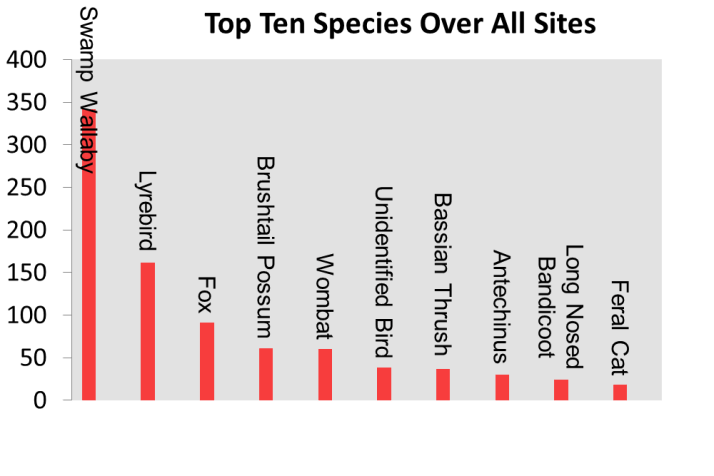
This table shows the combined number of species results for all cameras over 2 months.
Most Common Species - All Sites
Most Common Species – All Sites
Less Common Camera Sightings
Less Common Camera Sightings – All Sites


2013 Lyrebird Survey Report

Less than ideal conditions beckoned for this years count, indeed when I woke up at 5.15 am and heard the rain pelting down on the roof, I fired up the computer and  checked the rain radar and saw that it was going to continue to bucket down, (especially at Balook) for the foreseeable future. I put the text through to Ranger Craig, who soon phoned back and told me the decision had been made given the weather to postpone. He said he would go up anyway just in case anyone turned up, and I returned to bed.

Much to my surprise, 2 days later I heard the news, that when Craig arrived at the Visitors Centre there was quite a crowd, who despite the weather were raring to go (much kudos to those hardy souls).

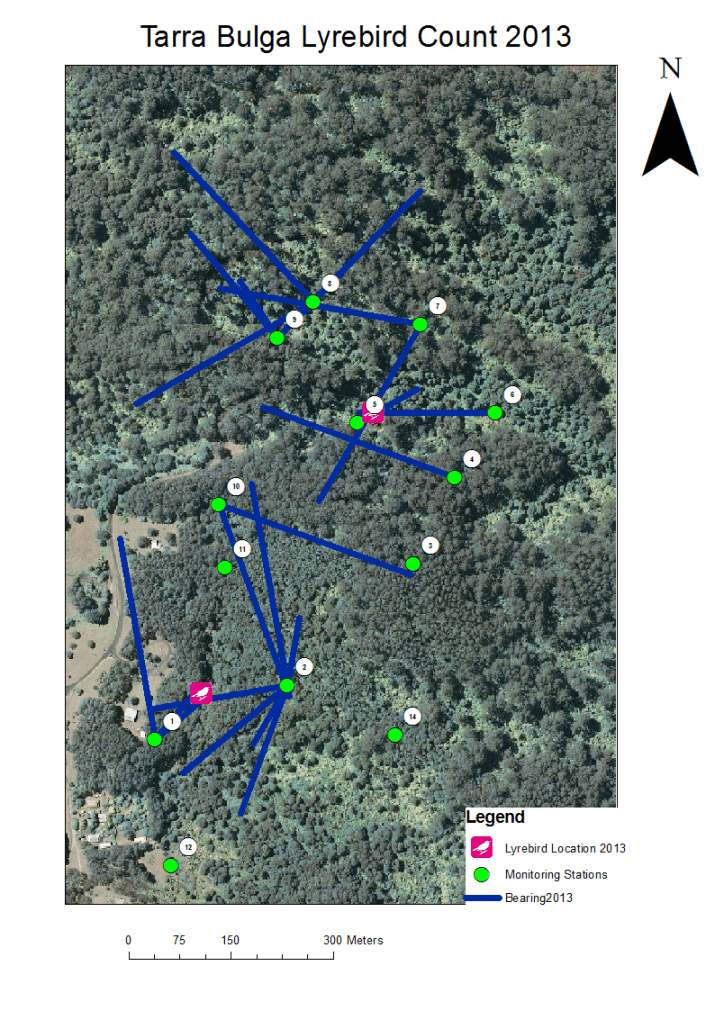
Reports suggest that the inclement weather may have influenced the survey, with several sites unusually recording no calls whatsoever. There were however Lyrebirds around with reports of a group foraging directly in front of the Visitors Centre. Possibly the much needed rain produced ideal conditions for the birds to feed, so inconveniently the boys were more focused on filling their stomachs, rather than attracting the ladies with their fancy calls. Despite the visual sightings, only two male birds within the survey area could be properly counted using our call based technique. Hopefully the drop in numbers can be attributable to the conditions, rather than more sinister reasons such as increased fox numbers. In any case I am sure we will be back next year with hopefully more favourable conditions to do it all again.  I also hope that despite the conditions that the hardy survey team had a great morning and the usual scrumptious breakfast at the guest house.

PS. To any of the attendees that braved the conditions and got a good photo of any aspect of the morning, it would be great if you could forward it on, so we could add it to this report.

lyrebird count 2013
Lyrebird Count Results 2013, two male birds only can be considered officially counted this year.
Related Posts

One, Two, Three, Four Lyrebirds, Let’s Count Some More.

It’s on again. The Friends of Tarra Bulga are looking for interested volunteers to participate in our Annual Lyrebird Survey on Saturday June the 1st.  The survey, which aims to help to monitor the health of the local Lyrebird population involves an early start. People need to be at the Tarra Bulga National Park Visitors Centre at 6am so we can get organised to get everyone to their monitoring positions before sunrise when the Lyrebirds will (hopefully) burst into song. The survey itself only takes about half an hour and following that as a reward for your support and the early start, a cooked breakfast is on the menu. If you would like to come along you need to contact ranger Craig Campbell (by Wednesday May the 29th on 5172 2508 or email craig.campbell@parks.vic.gov.au. Wear warm clothing, bring a watch, a torch and a compass (if you have one).

Lyrebird Count 2012
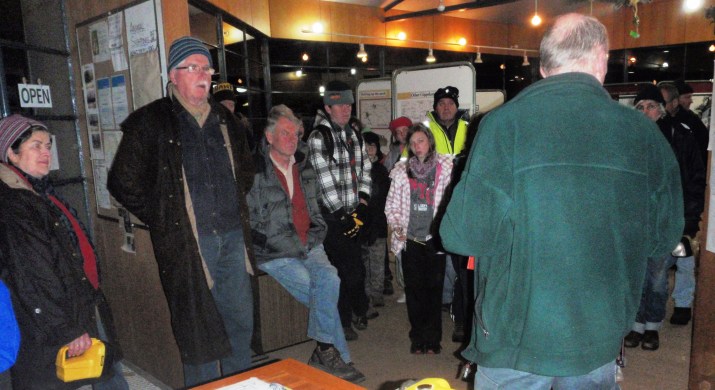
Volunteers line up to get final instructions before heading out to take their positions for last year’s survey.

Fungi Season

This time of the year (Late Autumn) is the best time for seeing the interesting array of Fungi present in Tarra Bulga National Park. A diversity of fungi species (in addition to the towering trees and lush ferns and mosses and the wildlife) make a visit well worth the effort.

Most of the photos shown in the gallery below were taken in two recent strolls around the Rainforest walks at both Bulga Park and the Tarra Valley, with the latter site having the most fungi on show. Tarra Valley has had a long history of being an interesting destination for fungi observation, Back In the 1950’s, Kara Healey (Victoria’s first female ranger) collected around 160 species of fungi from the Park area, two previously un-described species she collected were even named in her honor.

This slideshow requires JavaScript.

Fungi Map are holding their 7th Biennial iNational Conference in Gippsland later this month and the participants are spending a full day at the Park on Monday May 21st. More information can be found via this link.  https://www.fungimap.org.au/index.php/fungimap7fullproginfo Maybe you can go along and   learn a few things and then be able to assist us with identifying some of the species feature in this gallery!

Sycamore Maple Pull Site 2013 and Tutsan Rust

Last Saturday we held a working bee, weeding at a site (which we do annually) where an invasion of Sycamore Maple seedlings entered the Park from a surrounding property. Initially we were pulling out hundreds of new seedling and now the ongoing effort to remove newly detected seedlings is working well. Like last year there was not a lot of Maple to remove and a lot of the time was spent moving through the site to ensure that the area was clean of weeds, (although we did not get cross to the other side of the gully where there are some more Maples growing). The main area where Maple was found was an open disturbed area that also has a very bad Tutsan infestation.

It was interesting to discover that much of the Tustsan in the area was covered by rust with some foliage looking quite heavily impacted. We didn’t notice the rust last year but when I looked back at some photos I took then, I did see that some Tutsan leaves had tell tale rust spots present. Tutsan Rust (Melampsora hypericorum) is a fungus that was found to be very successful in the Otway Ranges in the 1990’s where it had a significant impact on reducing the cover of this shade tolerant invasive weed.

Our site (or somewhere in a close vicinity) had Tutsan Rust artificially introduced a couple of years back and after some follow up inspections It was thought that it had not taken. After a bit of research I found a document that suggested that Tutsan Rust was already present at Tarra Bulga, A report from 1999 describes rust taken from Tarra Bulga (as well as some from the Morwell River area) being used as part of research project. The Tarra Bulga rust was found to impact the plants in the trial to an intermediate level (i.e. OK but not great). Whether or not the rust is from the attempted introduction a couple of years ago (of which I assume was a more virulent strain) or whether it is the same rust that has been around for longer, can probably not be known without complex Laboratory analysis. But we will continue to monitor the site with interest given the threat that Tutsan presents to the park.

As well as the Maple and Tutsan there were new Blackberry seedlings that we carefully hand pulled as well as a few new outbreaks of English Ivy which we need to remain vigilant for. There were some larger clumps of Blackberry that will need to be sprayed.

Reference: Casonato, S, Lawrie, A. and McLaren, D. Biological control of Hypercium androsaemum with Melampsora hypercorum  In ’12th Australian Weeds Conference’. Hobart, Tasmania. (Eds AC Bishop, M Boersma, CD Barnes) pp. 339-342. (CAWSS).

Hypolepis – Ground Ferns

One of the trickiest groups of Ferns to identify locally are a group of Ground ferns in the Genus Hypolepis. There are three different species recorded in the park but I have only ever found two of them which are Hypolepis glandulifera (Downy Ground-fern) and Hypolepis rugulosa (Ruddy Ground-fern). Without looking carefully these ferns can be mistaken for Bracken because they have a similar growth habit with fronds popping up from a spreading underground rhizome.

Hypolepis rugulosa (Ruddy Ground-fern) seems to be more common locally at higher altitudes in the Park (e.g. Wet Forest areas around Balook). It seems to like disturbed areas at the sides of roads and tracks. Its main feature for identification in the field is the reddy-brown colour of the frond stems (Stipes).

Hypolepis glandulifera (Downy Ground-fern)  I have found mostly at lower altitudes, especially along waterways (e.g. Tarra River and Macks Creek). Its frond stems (Stipes) are usually a pale green colour. It usually has lots of fine hairs along the stems and the new fronds are often sticky to the touch as a result of the small glands on the tips of many of the hairs. If you have a hand lens or use a digital camera with a macro setting you can see that there is a little triangular tooth close to the sori on the underside of fertile fronds. This fern was formerly known as Hypolepis punctata.

Hypolepis muelleri (Harsh Ground-fern) is also listed in Park’s flora records for the but I have yet to find any. It can be identified by the presence of tiny hairs growing in the Sori on the underside of the fertile fronds.