Remote Camera Monitoring March 2013

Camera 1- Has been repaired after Lyrebird attack and will be back in action ASAP.

 Camera 2 – is  still placed in an area that has quite prolific wildlife sightings.

This month it captured a variety of birds, which surprisingly is not always the case given the diversity of species in the park. Birds pictured were the Yellow Robin, Crimson Rosella, Grey Shrike-thrush, Satin Bowerbird, Lyrebird, White-browed Scrub-wren and the Bassian Thrush, Also picked up some nice photos of Some very active Brushtails, Antechinus, Wombats and Echidnas. On the down side there was a feral Cat sneaking Foxes around and no sign of any Bandicoots. Apologies to the Wallabies we spotted having a rather private moment.

Tarra Valley South West
Tarra Valley South West – Species Count

Camera 3 – Was on a steep slope and this month produced a lot more photos, probably due to just a slight change of position which was aimed at more level ground. Grey Currawongs were hanging around the site along with Antechinus, Lyrebirds, Brushtail’s and Echindna’s. This was a much better result than the last time where only Foxes, Wallabies and Lyrebirds were detected.
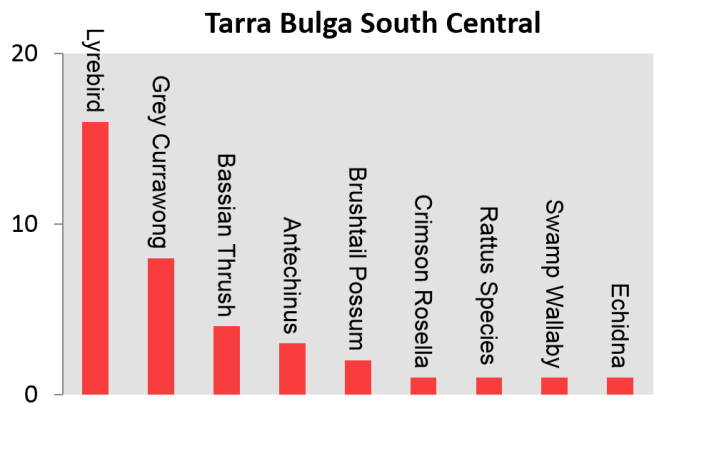
Tarra Bulga South Central
Tarra Bulga South Central – Species Count

Camera 4 – Was located at a site that was also surprisingly busy given that has a lower diversity because it is an area of shrubby regrowth forest with a ground cover of only bark, leaf litter and bare soil. Grey Currawongs again seemed to be active at the moment; Brush Bronzewings seem to like this area as well as Lyrebirds (sometimes in pairs). Crimson Rosellas, Eastern Whip-birds and Bassian Thrushes were also spotted. Wombats, Wallabies and Antechinus were the main mammals along with visits by two Feral Cats and a Fox. The results were similar to last time and the camera has now been moved into some different habitat.

Balook West - Camera 4
Balook West – Camera 4, Species Counts

Camera 5 This camera was located at the bottom of a damp fern gully, With only 400 photos in the six week period it was actually a bit quieter than some of the other locations, although there was a lot of Brush-tailed possum activity (Good spot for Powerful Owls to get some tucker!!) and a lot of Pilotbird activity. Other Mammal species were an unidentified rodent, Antechinus, Wallabies and the ubiquitous Foxes (which were seen at all 7 Camera sites scattered around the park).

Balook Gully
Balook Gully Species Count

Camera 6 – Is a site located close to old-growth forest, it has deep leaf litter on the ground. Surprisingly we haven’t been picking up a lot of diversity here. There has been lots of Lyrebirds photographed as well as Wallabies and Foxes but little else. Potentially the camera is too high to pick up smaller species. I have made an adjustment to see if it makes any difference.

Tarra Bulga North West - Species Count
Tarra Bulga North West – Species Count

Camera 7 – Was in the same place as last time and once again it was prolific even though the vegetation is mainly scrubby regrowth with no large canopy trees. Again there were lots of cute mother Wallaby and Joey in pouch photos. There were more good shots of Long-nosed Bandicoots and Lyrebirds. Other birds were Pied Currawongs and Grey shrike-Thrushes. There were some busy Wombats and some handsome looking but evil Foxes no doubt sniffing around for a meal of fresh Bandicoot.

Balook West - Species Count
Balook West – Species Count

Camera 8 –No sign of any snakes this time, but similar results to last time at this site which was on the Eastern edge of Tarra Bulga. Lots of Lyrebird activity, Wombats, Wallabies and Echidnas as well as some Long-nosed Bandicoots and Foxes.
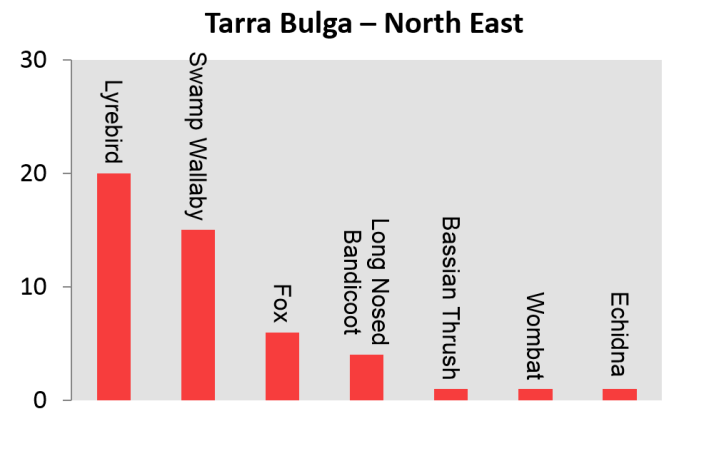
Tarra Bulga North East
Tarra Bulga North East – Species Count

Lance, Strap and Ray the Water Ferns

With names like Lance, Strap and Ray this lot of Water-ferns sound like rather a threatening bunch, but in reality they are probably not so tough. All preferring to grow locally in the moist shade found in Cool Temperate Rainforest. All of these species can be found fairly easily in both the Bulga Park and Tarra Valley rainforest walks. Overall seven species of Blechnum grow in Tarra Bulga National Park.

Lance Water-fern (Blechnum chambersiilike all the local water ferns (Blechnum species) apart from one have two distinctly different frond types. The ones that carry the reproductive spores on their undersides have very narrow and droopy pinnae (leaves). The regular fronds are dark green and the leaflets (pinnae) are curved and broad at the base where they are attached to the stem.

Ray Water-fern (Blechnum fluviatile) The regular fronds have small green oblong to oval shaped pinnae (leaflets) with rounded tips. The stems of the fronds (Rachis) are covered in scales as well as small hairs.

Strap Water-fern (Blechnum patersoniiHas regular fronds that are either one long strap or may have a few pairs of divided pinnae which can give them a similar look to Microsorum pustulatum (Kangaroo Fern). The edges of the fronds are usually wavy (undulating). The regular fronds are also broader closer to the tip (and skinnier at the base), they are quite tough and leathery and are a very dark green colour. The spore carrying fertile fronds are much narrower and can also be a single strap or have a few narrow sub-divisions.

Blechnums: Hard and Soft Water Fern’s

Another post in our series for people wanting to know more about the fern species in Tarra Bulga National Park and how to identify them. Here we look at two more species of Blechnum. Hard Water-fern (Blechnum wattsii) and Soft Water-fern (Blechnum minus).

Blechnum wattsii – (Hard Water-fern) is much more common than the Soft Water-fern at Tarra Bulga and is found in both Cool Temperate Rainforest and Wet Schlerophyll forest areas. It has tough dark green fronds, a key feature is that the lower leaves (pinnae) on each stem (rachis) are only slightly smaller than the others.

Blechnum minus – (Soft Water-fern) is locally more restricted in its distribution and mainly confined to the banks of water-bodies. It’s fronds are a lighter shade of green and the margins of the pinnae are more undulating or wavy. A key feature of their identification is that the lower leaves (pinnae) on each stem is are much shorter than the rest and they are also widely spaced apart.

Both species are dimorphic meaning that the fertile fronds that contain the spores are different to the regular fronds, for both of these species they are a lot more slender than the regular fronds.

Related Posts

Awesome Lyrebird Story

Found this YouTube clip on the Museum Website. It is well worth a look it has some great old footage of Male Lyrebird displays.

Remote Camera Site Over One Month

The video shows a compilation of all the photos taken at one site, by one of our infrared cameras over the period of one month. It shows the typical comings and goings of the local fauna, It was taken a year ago.  If you look at the top of the screen you can see the date and time that each animal visited. We haven’t been using bait to lure animals to the camera, we did try that initially but it didn’t seem to make much difference to the numbers or variety of the species photographed. Camera placement can make quite a big difference to the animals filmed. If the camera is too high off the ground it seems to pick up less of the smaller animals such as Antechinus, Rats and Bandicoots (this camera was probably not low enough to the ground to pick them up at this site)

2012 Sycamore Maple Planting Project Site Update

Biggest Seedling
We have a winner this is the biggest planted tree I found on the site.

Recently trekked in to monitor progress I had been putting it off until the heat wave had passed. It was four and half months since I had last seen the site so I was anxious to see how things were progressing. First impressions where that there has been a lot of regrowth of under-storey the Snowy daisy-bush (Olearia lirata) had really taken off, and it was even harder to move around the site and to spot the Mountain Ash we had planted. With careful searching the good news was that the planted trees were still there and looking healthy and mostly untouched by Wallabies although I was expecting a bit more growth over summer.

Lots of re-sprouting on this Maple stump
Sycamore Maple stump with lots of re-sprouting that will need to be treated.

The other concern I had was how much regeneration there had been of the Sycamore Maple trees that had dominated this site until they were cut down cleared several years ago. When I had visited in October there were hundreds of new seedlings that had popped up since our planting day in August. I was happy to see that in the more open areas there were few if any Maples (I think the hot summer may have killed them off) it was noticeable however that some of the large stumps had varying amounts of re-shooting from the base that needs to be dealt with.

Do you want fries with that?

Hopefully they won’t be a huge threat to the ecology of Tarra-Bulga National Park but it was interesting to spot this crop of potatoes that seem to have become naturalised in a small patch in the park on the roadside along the Bulga Park Rd.

Tarra Bulga Spud
Tarra Bulga Spud
Potato plants on the edge of the gully.
Potato plants on the edge of a gully along Bulga Park Road.