2013 Lyrebird Survey Report

Less than ideal conditions beckoned for this years count, indeed when I woke up at 5.15 am and heard the rain pelting down on the roof, I fired up the computer and  checked the rain radar and saw that it was going to continue to bucket down, (especially at Balook) for the foreseeable future. I put the text through to Ranger Craig, who soon phoned back and told me the decision had been made given the weather to postpone. He said he would go up anyway just in case anyone turned up, and I returned to bed.

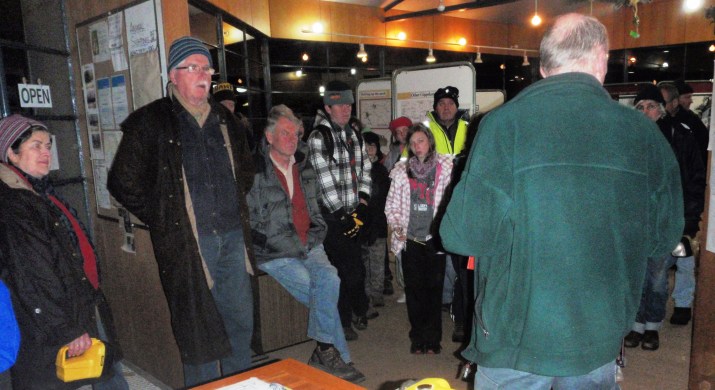
Much to my surprise, 2 days later I heard the news, that when Craig arrived at the Visitors Centre there was quite a crowd, who despite the weather were raring to go (much kudos to those hardy souls).

Reports suggest that the inclement weather may have influenced the survey, with several sites unusually recording no calls whatsoever. There were however Lyrebirds around with reports of a group foraging directly in front of the Visitors Centre. Possibly the much needed rain produced ideal conditions for the birds to feed, so inconveniently the boys were more focused on filling their stomachs, rather than attracting the ladies with their fancy calls. Despite the visual sightings, only two male birds within the survey area could be properly counted using our call based technique. Hopefully the drop in numbers can be attributable to the conditions, rather than more sinister reasons such as increased fox numbers. In any case I am sure we will be back next year with hopefully more favourable conditions to do it all again.  I also hope that despite the conditions that the hardy survey team had a great morning and the usual scrumptious breakfast at the guest house.

PS. To any of the attendees that braved the conditions and got a good photo of any aspect of the morning, it would be great if you could forward it on, so we could add it to this report.
lyrebird count 2013
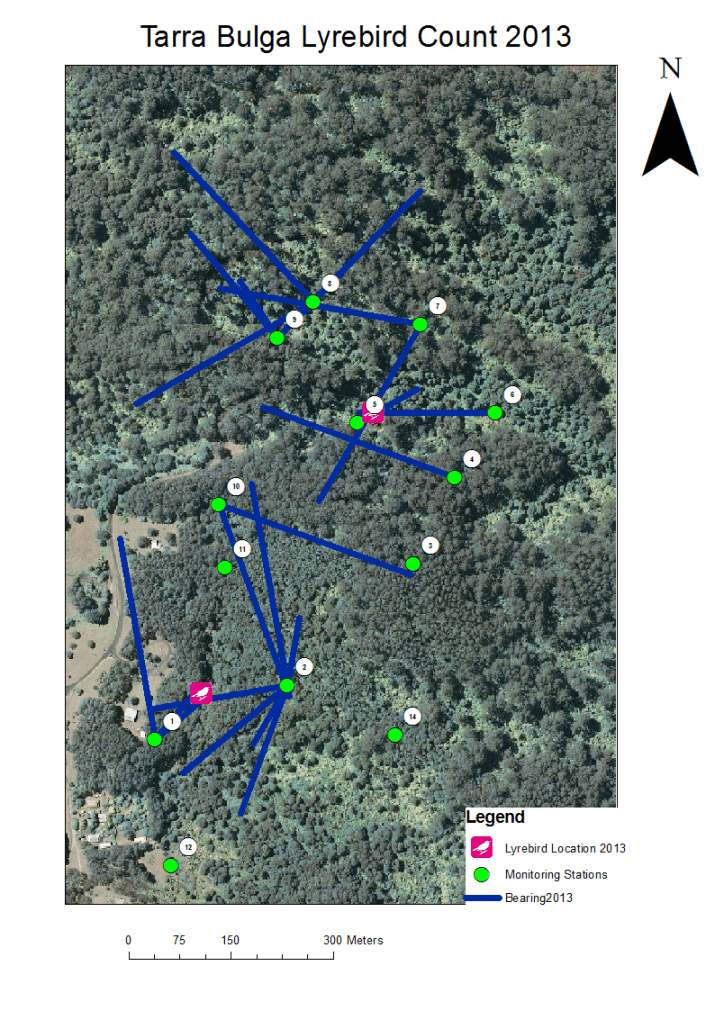
Lyrebird Count Results 2013, two male birds only can be considered officially counted this year.
Related Posts

One, Two, Three, Four Lyrebirds, Let’s Count Some More.

It’s on again. The Friends of Tarra Bulga are looking for interested volunteers to participate in our Annual Lyrebird Survey on Saturday June the 1st.  The survey, which aims to help to monitor the health of the local Lyrebird population involves an early start. People need to be at the Tarra Bulga National Park Visitors Centre at 6am so we can get organised to get everyone to their monitoring positions before sunrise when the Lyrebirds will (hopefully) burst into song. The survey itself only takes about half an hour and following that as a reward for your support and the early start, a cooked breakfast is on the menu. If you would like to come along you need to contact ranger Craig Campbell (by Wednesday May the 29th on 5172 2508 or email craig.campbell@parks.vic.gov.au. Wear warm clothing, bring a watch, a torch and a compass (if you have one).

Lyrebird Count 2012
Volunteers line up to get final instructions before heading out to take their positions for last year’s survey.

Awesome Lyrebird Story

Found this YouTube clip on the Museum Website. It is well worth a look it has some great old footage of Male Lyrebird displays.

Remote Camera Site Over One Month

The video shows a compilation of all the photos taken at one site, by one of our infrared cameras over the period of one month. It shows the typical comings and goings of the local fauna, It was taken a year ago.  If you look at the top of the screen you can see the date and time that each animal visited. We haven’t been using bait to lure animals to the camera, we did try that initially but it didn’t seem to make much difference to the numbers or variety of the species photographed. Camera placement can make quite a big difference to the animals filmed. If the camera is too high off the ground it seems to pick up less of the smaller animals such as Antechinus, Rats and Bandicoots (this camera was probably not low enough to the ground to pick them up at this site)

Remote Camera Monitoring – Update Summer 2013

This post is a summary of the Remote Camera Monitoring results over December and January 2012/13

Camera  1 – Still out of action after it was attacked by an aggressive lyrebird.

Lyrebird who got overly interested in one of our Remote Cameras

Camera 2 – Located in mature Wet Forest in the Tarra Valley was quite a prolific site, with the camera picking up lots of small birds e.g. White-browed Scrub Wrens and Bassian and Grey-Shrike Thrushes, as well as mammals such as Antechinus and Long-nosed Bandicoots, unfortunately there were plenty of Foxes and a Feral Cat present. Also plenty of Wombats, Wallabies and some Brushtails.

Superb Lyrebird – Compost Machine

This video made up from a series of still photos from one of our remote cameras along with some sound recorded by our songmeter shows a Male Superb Lyrebird systematically scratching around for food underneath the leaf litter. This scratching results in the leaf litter being turned over and is thought to improve the rate of nutrient cycling in the forest, helping to create compost that will feed the vegetation.

Strzelecki Koala

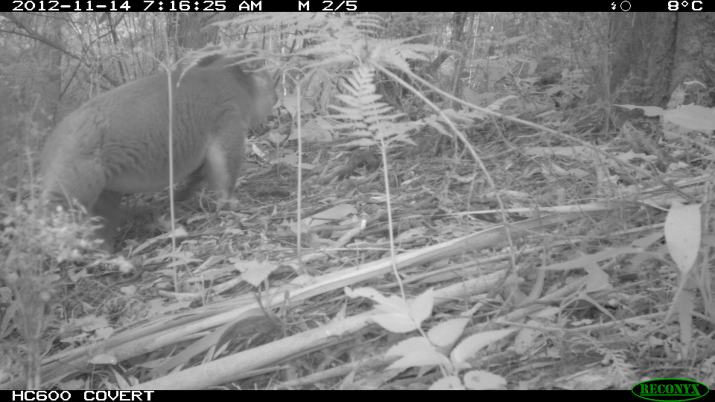
We have had what we hope is the first of many Koala’s detected by our remote cameras. This one was on the  move past our camera site in the Tarra Valley. Koala sightings seem to be reported more frequently in the park in recent years, but this is only anecdotal as no proper ongoing survey has ever taken place. Importantly the park is part of the habitat of the Strzelecki Koala population, which is significant because the local Koalas are thought to be the only population in the state that are not descended from a handful of trans-located  Koalas from French Island and hence are thought to be much healthier and genetically resilient.

Koala at Tarra Bulga
This Koala is the first one we have seen one via our Remote Camera monitoring program.

This Koala was in an area of the Park that has some very large Mountain Grey-gum trees, (Eucalyptus cypellocarpa) which researchers believe is one of the local Koalas’ favourite food sources. Although not their first choice Mountain Ash (Eucalyptus regnans); which is the most common eucalypt within the park is thought to also be utilisted by Koalas as well as Messmate (Eucalyptus obliqua) which is also quite common. We would love to hear about any sightings in the park to add to our knowledge and to help contribute to regional efforts that are being made to get a better understanding about the distribution of the Strzelecki Koala and its health and well being.