Technology today has made it super-easy to dig up fascinating old newspaper articles like this one below from the Argus in 1925. We would have to think that the author would be fairly astounded if they could step forward in time and visit the Tarra-Bulga today. What will it be like 88 years from now??
THE TARRA VALLEY.
When in 1840 Strzelecki led an expedition from New South Wales over Mount Kosciusko and through Gippsland to Corinella, on Westernport Bay one of the party was an Australian aborigine named Charley Tarra. The choice of this native was fortunate for in the latter part of the journey when food supplies were exhausted it was Charley Tarra’s prowess as a hunter that saved the party from starvation.
To such straits were they reduced to in the last 50 miles – and so wild and rough was the country that it took them 22 days to hew their way through the bush – that they lived almost wholly on the flesh of Koalas or native bears. A few months later when a party from Melbourne chartered a vessel to carry them to the newly discovered province, they took with them Charley Tarra, and when they, or rather some of them were cutting their through the tangled way undergrowth back towards Westernport Tarra’s gun frequently provided the hungry travelers with bear flesh. Which if not tasty, at any rate had food value, It was therefore fitting that Tarra’s name should be preserved in the nomenclature of the streams of Gippsland and, on a river rising in the hills 10 0r 12 miles from where the town of Yarram has since been built, and flowing through a wilderness of bush and fern trees, was bestowed the name of Tarra. It is not an imposing stream, and along most of its course the beautiful surroundings have vanished.
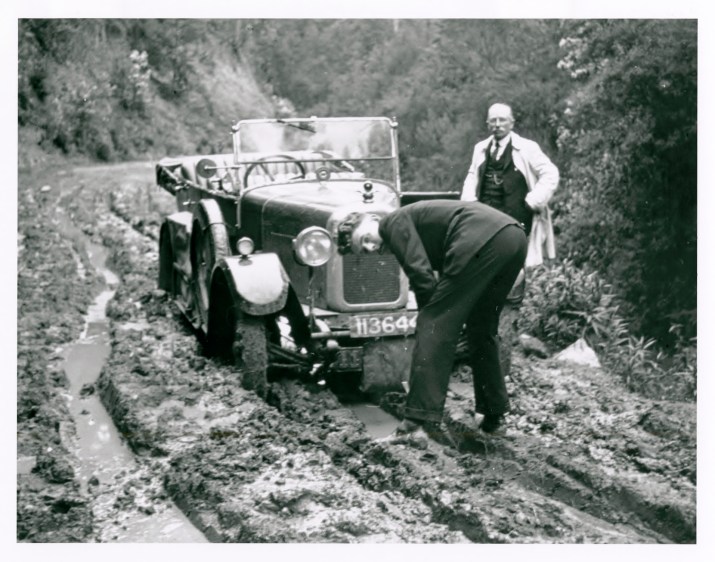
Making a Hill Road (Source: Monash University Centre for Gippsland Studies)
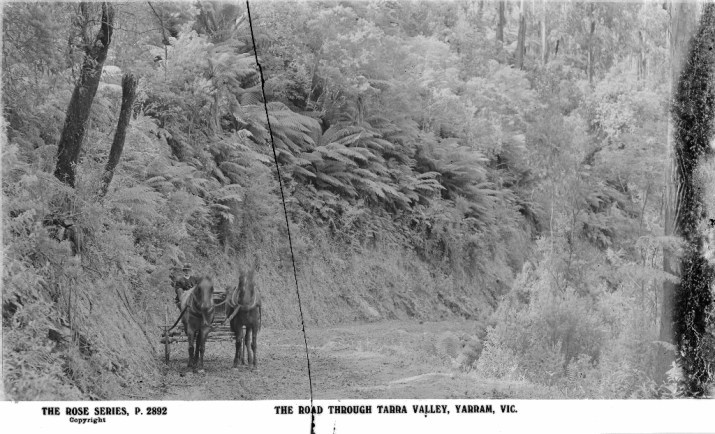
As one wanders in South Gippsland with its hundreds of bare hills or if not bare then covered only with dead eucalypts, or through the lower lands that have nearly all been devastated by fire, it is difficult to picture what this great territory was like when it was first explored, or even to visualise it as it was half a century ago. But a page or two of “the universal and public manuscript” that at one time was expanded to the eye of all can still be seen in the upper part of the valley through which the Tarra River flows. They are not unsullied pages, for every here and there one comes on patches of dead trees looking like phantoms of the surrounding living giants, with their marble like boles. On the hills and in the valleys, the fern trees rise above a tangled wilderness of blanket-wood, hazel, and other scrubs peculiar to the virgin mountain forests of Victoria. Far down in the main valley and in the trackless ways of the Tarra’s gully tributaries are bowers of myrtles of various sizes and conditions, some lithe and fresh others old and hung with lichens. Along the road over the hill big hearted settlers, in spite of great difficulties and discouragement, have built homes and cultivated little clearings.
Hill farm in the Tarra Valley – (Source: Monash Uni Gipps Studies)
In some cases, however, the odds have proved too tremendous, and scrub and bracken are almost hiding from view the abandoned homesteads. Near the top of the range where the Tarra River has its source is a timber mill, and though all the machinery is still there it seems a long while since the mill was in operation Scores of white logs mark an old timber trail now partly over grown with young scrub, and the bush is gradually creeping back around the mill and the timber-getters’ huts.
Car at Tarra Valley – Source: Monash Gipps Studies.
Near its source the scenery of the Tarra River is not surpassed by the beauty of any other valley in the State, but it is not likely to attract tourists. For the greater part of the year the road through it is almost impossible for motors, and there is too much stale, flat, and unprofitable country to be gone through to make the trip suitable for a walking tour. The bit of wild bush that is left is but a scrap of a mighty forest that 50 years ago covered South Gippsland, and this probably must ere long be destroyed and the name of the Tarra Valley be recorded only in the catalogue of things that were and cannot be again.
The Road Through Tarra Valley (Source: State Library of Victoria)
It is a perfect time to visit Tarra Bulga at present because #spring flowers are currently at their peak. The photo gallery attached shows some of the species that are out in Flower at present, get up their and have a look and see what you can find. If you get any good shots please share them with us via our Facebook Page or this Blog.
After some very windy and cold weather at the end of winter including the snow of only a week and a half ago, the last day of winter was almost perfect. The first day of Spring tomorrow also promises to be just as good. Calm winds and blue skies made today a gem of a day to be at Tarra Bulga. Birds were all around, and spring flowers were starting to bloom. The Silver Wattles were bright yellow and sections of the walking tracks were covered in fallen Sassafras flowers. A Male Lyrebird landing on a tree just above my head was a breathtaking moment on such an ideal day to be in such a magnificent place.
Asplenium’s or Spleenworts are a very interesting group of ferns and at Tarra Bulga there are three species that can be found. One of them is common in Rainforest gullies while the other two are harder to find. It is not hard to tell each one apart although there may me some hybridisation happening between two of the species which can be confusing.
This is common in the park mainly in rain forest gullies, it grows as epiphytes on tree and fern trunks as well as on shady banks, and among rocks. It can be potentially confused with other ferns that grow in this habitat such Shiny or Leathery Shield-fern. An impressive feature of this fern is its ability to reproduce via bulbils that can form on the tips of the fronds, giving rise to its common name “mother” as well as the Latin one. A good way to distinguish it from other ferns is to locate the linear to oblong shaped sori on the margins of the underside of the fertile fronds and to look for the many tiny brown scales on the surface of the stem and the fronds.
Weeping Spleenwort is very uncommon in the Park, hopefully there is more hidden away in some gully that we don’t know about, but we only really know about one living plant that currently exists here. Compared to Mother Spleenwort it has linear to oblong pinnules that are not lobed. The pinnules are widely spaced on the long Weeping Fronds. It only has a few scattered scales.
This slideshow requires JavaScript.
Necklace Fern – Asplenium flabellifolium
Necklace fern is unlikely to be found in the Cool Temperate Rainforest areas in Tarra Bulga, it is more often in sheltered shady spots (e.g.) along road cuttings in more exposed sections of the park. It is more common at lower altitudes in the district, e.g. in the Warm Temperate Rainforest of Macks Creek. It is easily distinguished from the other local Asplenium species with its small slender green fronds having fan shaped leaflets (pinnae), forming what could be described as a necklace.
This slideshow requires JavaScript.
Possible Hybrid???
According to some sources Aspleniums are known to hybridise across species. Several plants that I photographed along the Fern Gully Track at Bulga Park, seem to have features somewhere intermediate between Mother Spleenwort (Asplenium bulbiferum) and Weeping Spleenwort (Asplenium flaccidium).
Filmy Ferns are a feature of the wet gullies and rainforests in Tarra Bulga, they are usually found as epiphytes growing on the trunks of trees and other ferns, especially Soft tree-fern (Dicksonia antarctica) as well as rocks and steep embankments . There are five different species known to occur in the park and although they are small and delicate, with a bit of practice it is easy enough to learn to tell the difference between each species. Four of them belong to the same genus (Hymenophyllum). Along with the Filmy ferns there are many species of Mosses and Liverworts that flourish in similar moist sheltered locations.
Click on the Galleries for Closer Views and Photo Descriptions
Austral Filmy-fernHymenophyllum australe
This fern is dark green and not particularly shiny. It is common and easy to identify by the wing which is several millimetres wide and extends all the way along the central wiry stem from the tip of the frond to the base (stipe) where it is attached. It has lots of spore producing sori at the tips of the fronds. The sori have 2 lips and they often present in pairs.
Winged stipe where it attaches to the rhizome.
Fertile frond with pairs of indusium covering sori.
Typical Frond
Close up of fertile frond with pairs of fertile sori.
Colony on Tree Fern
Shiny Filmy-fern Hymenophyllum flabellatum
This is another very common fern found in the rainforest gullies. As indicated by its common name it is very shiny and it is a lighter green than the Austral Filmy-fern. The stem (stipe) does not have a wing and has a tuft of hairs at the base. The pinnae (ends of the fronds) often form a fan shape. The sori (spore producing bits) at the tips of the frond segments are wider than the rest of the leaf.
Fan shaped frond segments
The stems (rachis) are not winged along the whole length.
Frond – Not the hairy base of the stem.
Frond
Colony
Shiny Frond with indusium at tip of segments.
Common Filmy-fern – Hymenophyllum cupressiforme
Common Filmy-fern is easily found and identified by serrated margins of its outer fronds. It has large spore producing sori which are located close to the main stem (rachis) of the frond. Alpine Filmy-fern (Hymenophyllum pelatum) also has serrated margins of it frond segments (pinnae) but it has never been found in the Tarra Bulga.
Indusium, close to rachis.
Colony
Frond, note the serrated margins.
Large black sori located close to the central stem.
Narrow Filmy-fern – Hymenophyllum rarum
As its Latin name suggests this fern is the hardest to find of all the local species. It will often grow among Common – Filmy fern (e.g. Along the East-West track in the Tarra Valley picnic area) and superficially looks similar. As its common name suggests it is narrow, It has a narrow wing along its main stem which may cause confusion with Austral Filmy-fern, but a clear distinguishing feature is the the V shape made by the veins at the base of the indusium (tissue protecting the spores) at the tips of fertile frond segments. Click on the Gallery below for a better view.
With V shaped veins at the tip (below the indusium)
Narrow Frond
Where stipe attaches to the rhizome.
With V shaped veins at the tip (below the indusium)
Fronds segments divide on one half only.
Close up (magnified) of tips of fertile fronds. Note V shaped veins.
Frond has a narrow wing.
Veined Bristle-fern – Polyphlebium venosum
Is the only species of the 5 ferns not in the genus Hymenophyllum. It is very common in the same habitats as the other occur. It is distinguished by its very delicate pale green shiny fronds (only one cell thick). Tiny branched veins are clearly visible on the narrow fronds. The fertile fronds have a trumpet shaped spore cover (indusium).
Typical Frond
Network of veins are easily visible.
Fertile fronds with trumpet shaped indusium protecting the sori.
This time of the year (Late Autumn) is the best time for seeing the interesting array of Fungi present in Tarra Bulga National Park. A diversity of fungi species (in addition to the towering trees and lush ferns and mosses and the wildlife) make a visit well worth the effort.
Most of the photos shown in the gallery below were taken in two recent strolls around the Rainforest walks at both Bulga Park and the Tarra Valley, with the latter site having the most fungi on show. Tarra Valley has had a long history of being an interesting destination for fungi observation, Back In the 1950’s, Kara Healey (Victoria’s first female ranger) collected around 160 species of fungi from the Park area, two previously un-described species she collected were even named in her honor.
This slideshow requires JavaScript.
Fungi Map are holding their 7th Biennial iNational Conference in Gippsland later this month and the participants are spending a full day at the Park on Monday May 21st. More information can be found via this link. https://www.fungimap.org.au/index.php/fungimap7fullproginfo Maybe you can go along and learn a few things and then be able to assist us with identifying some of the species feature in this gallery!
Last Saturday we held a working bee, weeding at a site (which we do annually) where an invasion of Sycamore Maple seedlings entered the Park from a surrounding property. Initially we were pulling out hundreds of new seedling and now the ongoing effort to remove newly detected seedlings is working well. Like last year there was not a lot of Maple to remove and a lot of the time was spent moving through the site to ensure that the area was clean of weeds, (although we did not get cross to the other side of the gully where there are some more Maples growing). The main area where Maple was found was an open disturbed area that also has a very bad Tutsan infestation.
It was interesting to discover that much of the Tustsan in the area was covered by rust with some foliage looking quite heavily impacted. We didn’t notice the rust last year but when I looked back at some photos I took then, I did see that some Tutsan leaves had tell tale rust spots present. Tutsan Rust (Melampsora hypericorum) is a fungus that was found to be very successful in the Otway Ranges in the 1990’s where it had a significant impact on reducing the cover of this shade tolerant invasive weed.
Our site (or somewhere in a close vicinity) had Tutsan Rust artificially introduced a couple of years back and after some follow up inspections It was thought that it had not taken. After a bit of research I found a document that suggested that Tutsan Rust was already present at Tarra Bulga, A report from 1999 describes rust taken from Tarra Bulga (as well as some from the Morwell River area) being used as part of research project. The Tarra Bulga rust was found to impact the plants in the trial to an intermediate level (i.e. OK but not great). Whether or not the rust is from the attempted introduction a couple of years ago (of which I assume was a more virulent strain) or whether it is the same rust that has been around for longer, can probably not be known without complex Laboratory analysis. But we will continue to monitor the site with interest given the threat that Tutsan presents to the park.
As well as the Maple and Tutsan there were new Blackberry seedlings that we carefully hand pulled as well as a few new outbreaks of English Ivy which we need to remain vigilant for. There were some larger clumps of Blackberry that will need to be sprayed.










 Friends of Tarra-Bulga National Park