It’s on again. The Friends of Tarra Bulga are looking for interested volunteers to participate in our Annual Lyrebird Survey on Saturday June the 1st. The survey, which aims to help to monitor the health of the local Lyrebird population involves an early start. People need to be at the Tarra Bulga National Park Visitors Centre at 6am so we can get organised to get everyone to their monitoring positions before sunrise when the Lyrebirds will (hopefully) burst into song. The survey itself only takes about half an hour and following that as a reward for your support and the early start, a cooked breakfast is on the menu. If you would like to come along you need to contact ranger Craig Campbell (by Wednesday May the 29th on 5172 2508 or email craig.campbell@parks.vic.gov.au. Wear warm clothing, bring a watch, a torch and a compass (if you have one).
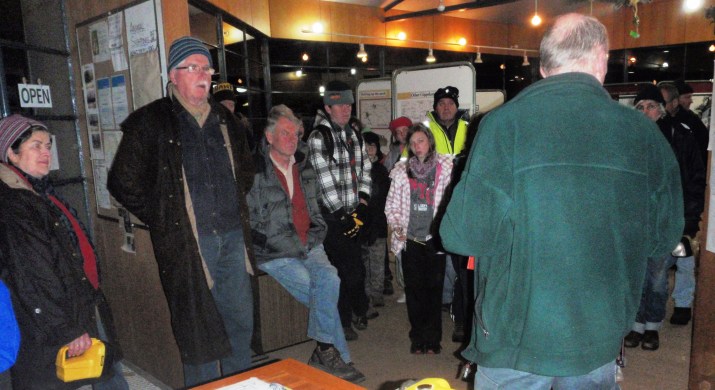
Volunteers line up to get final instructions before heading out to take their positions for last year’s survey.
This time of the year (Late Autumn) is the best time for seeing the interesting array of Fungi present in Tarra Bulga National Park. A diversity of fungi species (in addition to the towering trees and lush ferns and mosses and the wildlife) make a visit well worth the effort.
Most of the photos shown in the gallery below were taken in two recent strolls around the Rainforest walks at both Bulga Park and the Tarra Valley, with the latter site having the most fungi on show. Tarra Valley has had a long history of being an interesting destination for fungi observation, Back In the 1950’s, Kara Healey (Victoria’s first female ranger) collected around 160 species of fungi from the Park area, two previously un-described species she collected were even named in her honor.
This slideshow requires JavaScript.
Fungi Map are holding their 7th Biennial iNational Conference in Gippsland later this month and the participants are spending a full day at the Park on Monday May 21st. More information can be found via this link. https://www.fungimap.org.au/index.php/fungimap7fullproginfo Maybe you can go along and learn a few things and then be able to assist us with identifying some of the species feature in this gallery!
Last Saturday we held a working bee, weeding at a site (which we do annually) where an invasion of Sycamore Maple seedlings entered the Park from a surrounding property. Initially we were pulling out hundreds of new seedling and now the ongoing effort to remove newly detected seedlings is working well. Like last year there was not a lot of Maple to remove and a lot of the time was spent moving through the site to ensure that the area was clean of weeds, (although we did not get cross to the other side of the gully where there are some more Maples growing). The main area where Maple was found was an open disturbed area that also has a very bad Tutsan infestation.
It was interesting to discover that much of the Tustsan in the area was covered by rust with some foliage looking quite heavily impacted. We didn’t notice the rust last year but when I looked back at some photos I took then, I did see that some Tutsan leaves had tell tale rust spots present. Tutsan Rust (Melampsora hypericorum) is a fungus that was found to be very successful in the Otway Ranges in the 1990’s where it had a significant impact on reducing the cover of this shade tolerant invasive weed.
Our site (or somewhere in a close vicinity) had Tutsan Rust artificially introduced a couple of years back and after some follow up inspections It was thought that it had not taken. After a bit of research I found a document that suggested that Tutsan Rust was already present at Tarra Bulga, A report from 1999 describes rust taken from Tarra Bulga (as well as some from the Morwell River area) being used as part of research project. The Tarra Bulga rust was found to impact the plants in the trial to an intermediate level (i.e. OK but not great). Whether or not the rust is from the attempted introduction a couple of years ago (of which I assume was a more virulent strain) or whether it is the same rust that has been around for longer, can probably not be known without complex Laboratory analysis. But we will continue to monitor the site with interest given the threat that Tutsan presents to the park.
As well as the Maple and Tutsan there were new Blackberry seedlings that we carefully hand pulled as well as a few new outbreaks of English Ivy which we need to remain vigilant for. There were some larger clumps of Blackberry that will need to be sprayed.
One of the trickiest groups of Ferns to identify locally are a group of Ground ferns in the Genus Hypolepis. There are three different species recorded in the park but I have only ever found two of them which are Hypolepis glandulifera (Downy Ground-fern) and Hypolepis rugulosa (Ruddy Ground-fern). Without looking carefully these ferns can be mistaken for Bracken because they have a similar growth habit with fronds popping up from a spreading underground rhizome.
Hypolepis rugulosa (Ruddy Ground-fern) seems to be more common locally at higher altitudes in the Park (e.g. Wet Forest areas around Balook). It seems to like disturbed areas at the sides of roads and tracks. Its main feature for identification in the field is the reddy-brown colour of the frond stems (Stipes).
Base of frond (stipe) where it comes out of the ground, Chestnut brown with hairs.
Underside of fertile fronds showing arrangement of sori.
Topside of pinnae which are slightly harsh.
Frond
Hypolepis rugulosa – Ruddy Ground Fern
Close up of underside of pinnule. Showing little flap with a few hairs next to the sori.
Hypolepis rugulosa – Ruddy Ground Fern
New frond (crozier) not stickly like Downy – Ground-fern.
Ready brown frond stem (stipe) with small hairs.
Frond showing red-brown coloured stem (Rachis)
Red-brown frond stem (Rachis)
Hypolepis glandulifera (Downy Ground-fern) I have found mostly at lower altitudes, especially along waterways (e.g. Tarra River and Macks Creek). Its frond stems (Stipes) are usually a pale green colour. It usually has lots of fine hairs along the stems and the new fronds are often sticky to the touch as a result of the small glands on the tips of many of the hairs. If you have a hand lens or use a digital camera with a macro setting you can see that there is a little triangular tooth close to the sori on the underside of fertile fronds. This fern was formerly known as Hypolepis punctata.
Sori have a small tooth shaped flap protecting them. (note this photo is magnified)
Pinnules usually have rounded tips.
Underside of a fertile frond, packed with sori.
Typical Frond
Close up of frond stem (stipe) with soft hairs, some of them with glandular tips.
New frond, which is sticky to the touch because of the soft glandular hairs.
Showing the base of the fronds. Mostly a light green colour.
Hypolepis muelleri (Harsh Ground-fern)is also listed in Park’s flora records for the but I have yet to find any. It can be identified by the presence of tiny hairs growing in the Sori on the underside of the fertile fronds.
Camera 1- Has been repaired after Lyrebird attack and will be back in action ASAP.
Camera 2 – is still placed in an area that has quite prolific wildlife sightings.
This month it captured a variety of birds, which surprisingly is not always the case given the diversity of species in the park. Birds pictured were the Yellow Robin, Crimson Rosella, Grey Shrike-thrush, Satin Bowerbird, Lyrebird, White-browed Scrub-wren and the Bassian Thrush, Also picked up some nice photos of Some very active Brushtails, Antechinus, Wombats and Echidnas. On the down side there was a feral Cat sneaking Foxes around and no sign of any Bandicoots. Apologies to the Wallabies we spotted having a rather private moment.
Tarra Valley South West – Species Count
White-browed Scrub-wren
Wallaby with Bulging Pouch
Possum on Hind Legs
Lyrebird
Feral Cat
Echidna
Eastern Yellow-robin
Crimson Rosella
Brush-tail Possum
Bassian Thrush
Antechinus
Amorous Male Swamp Wallaby closely behind female.
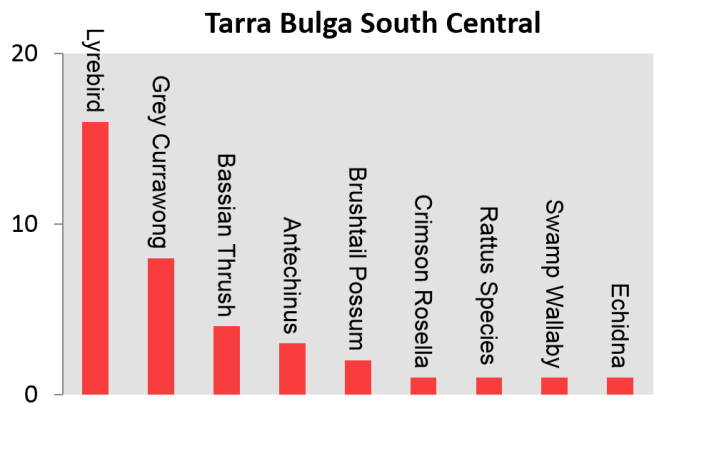
Camera 3 – Was on a steep slope and this month produced a lot more photos, probably due to just a slight change of position which was aimed at more level ground. Grey Currawongs were hanging around the site along with Antechinus, Lyrebirds, Brushtail’s and Echindna’s. This was a much better result than the last time where only Foxes, Wallabies and Lyrebirds were detected.
Tarra Bulga South Central – Species Count
Antechinus
Brush-tail Possum
Grey Currawong
Unidentified Rodent Species
Camera 4 – Was located at a site that was also surprisingly busy given that has a lower diversity because it is an area of shrubby regrowth forest with a ground cover of only bark, leaf litter and bare soil. Grey Currawongs again seemed to be active at the moment; Brush Bronzewings seem to like this area as well as Lyrebirds (sometimes in pairs). Crimson Rosellas, Eastern Whip-birds and Bassian Thrushes were also spotted. Wombats, Wallabies and Antechinus were the main mammals along with visits by two Feral Cats and a Fox. The results were similar to last time and the camera has now been moved into some different habitat.
Balook West – Camera 4, Species Counts
Another good shot of the Lyrebird
Antechinus
Bassian Thrush
Female Lyrebird
Feral Cat 2
Feral Cat
Fox
Pair of young Crimson Rosellas
Rodent on Tree
Male Superb Lyrebird 2
Superb Lyrebird
Swamp Wallaby
Unidentified bird possibly grey shrike thrush
Camera 5 This camera was located at the bottom of a damp fern gully, With only 400 photos in the six week period it was actually a bit quieter than some of the other locations, although there was a lot of Brush-tailed possum activity (Good spot for Powerful Owls to get some tucker!!) and a lot of Pilotbird activity. Other Mammal species were an unidentified rodent, Antechinus, Wallabies and the ubiquitous Foxes (which were seen at all 7 Camera sites scattered around the park).
Balook Gully Species Count
Young Swamp Wallaby
Rear of a Brush-tail Possum
Headless Brush-tail
Fox
Evening Lyrebird
Brushtail Possum
Bassian Thrush
Antechinus hiding under a branch
Camera 6 – Is a site located close to old-growth forest, it has deep leaf litter on the ground. Surprisingly we haven’t been picking up a lot of diversity here. There has been lots of Lyrebirds photographed as well as Wallabies and Foxes but little else. Potentially the camera is too high to pick up smaller species. I have made an adjustment to see if it makes any difference.
Tarra Bulga North West – Species Count
Fox
Swamp Wallaby
Camera 7 – Was in the same place as last time and once again it was prolific even though the vegetation is mainly scrubby regrowth with no large canopy trees. Again there were lots of cute mother Wallaby and Joey in pouch photos. There were more good shots of Long-nosed Bandicoots and Lyrebirds. Other birds were Pied Currawongs and Grey shrike-Thrushes. There were some busy Wombats and some handsome looking but evil Foxes no doubt sniffing around for a meal of fresh Bandicoot.
Balook West – Species Count
Wallabies
Wombat
Wallaby Mother
Very Long-nosed Bandicoot
Unidentified Bird
Tail sticking out of Pouch
Pied Currawongs
Pair of Lyrebirds
Pair of Lyrebirds
Lyrebird
Long-nosed Bandicoot
Long-nosed Bandicoot
Wallaby with Passenger
Fox
Common Wombat
Bandicoot
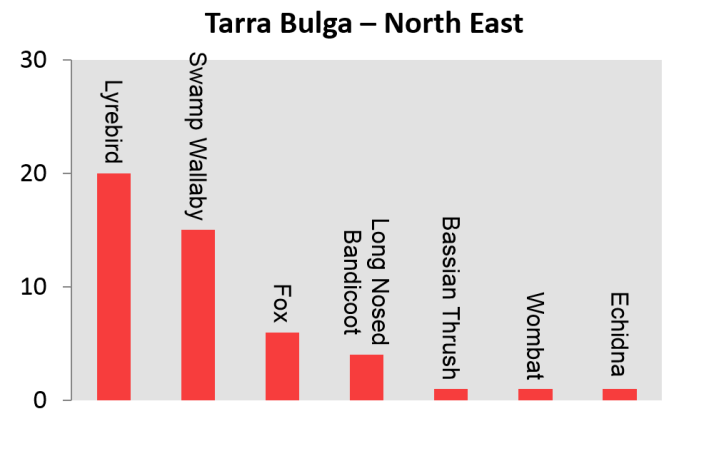
Camera 8 –No sign of any snakes this time, but similar results to last time at this site which was on the Eastern edge of Tarra Bulga. Lots of Lyrebird activity, Wombats, Wallabies and Echidnas as well as some Long-nosed Bandicoots and Foxes.
With names like Lance, Strap and Ray this lot of Water-ferns sound like rather a threatening bunch, but in reality they are probably not so tough. All preferring to grow locally in the moist shade found in Cool Temperate Rainforest. All of these species can be found fairly easily in both the Bulga Park and Tarra Valley rainforest walks. Overall seven species of Blechnum grow in Tarra Bulga National Park.
Lance Water-fern (Blechnum chambersii) like all the local water ferns (Blechnum species) apart from one have two distinctly different frond types. The ones that carry the reproductive spores on their undersides have very narrow and droopy pinnae (leaves). The regular fronds are dark green and the leaflets (pinnae) are curved and broad at the base where they are attached to the stem.
Close up of the pinnae.
Curved pinnae with the wide bases.
Fertile frond, narrower than than the regular fronds.
Underside of the fertile fronds showing the arrangement of the sori.
Ray Water-fern (Blechnum fluviatile) The regular fronds have small green oblong to oval shaped pinnae (leaflets) with rounded tips. The stems of the fronds (Rachis) are covered in scales as well as small hairs.
Fertile fronds packed with spore producing sori.
Long narrow regular fronds.
Regular fronds with small rounded pinnae.
Regular (green) and fertile (brown) fronds.
Stem (Rachis) note the scales and the fine hairs.
Strap Water-fern (Blechnum patersonii) Has regular fronds that are either one long strap or may have a few pairs of divided pinnae which can give them a similar look to Microsorum pustulatum (Kangaroo Fern). The edges of the fronds are usually wavy (undulating). The regular fronds are also broader closer to the tip (and skinnier at the base), they are quite tough and leathery and are a very dark green colour. The spore carrying fertile fronds are much narrower and can also be a single strap or have a few narrow sub-divisions.
Dark green strap like fronds.
In this case the frond is divided and looks a bit like Kangaroo Fern.
Typical plant with long strap like fronds.
A fertile frond covered with spore producing sori.
Another post in our series for people wanting to know more about the fern species in Tarra Bulga National Park and how to identify them. Here we look at two more species of Blechnum. Hard Water-fern (Blechnum wattsii) and Soft Water-fern (Blechnum minus).
Blechnum wattsii – (Hard Water-fern) is much more common than the Soft Water-fern at Tarra Bulga and is found in both Cool Temperate Rainforest and Wet Schlerophyll forest areas. It has tough dark green fronds, a key feature is that the lower leaves (pinnae) on each stem (rachis) are only slightly smaller than the others.
Blechnum wattsii – Hard Water-fern – Underside Fertile Pinnae, which are narrow and covered in spore producing sori.
Showing lower pinnae of Hard Water-fern at the top of the photo which are only slightly smaller than the ones on the rest of the frond.
Blechnum wattsii – Hard Water-fern – showing where the pinnae are attached by a very sort stalk
Blechnum wattsii – Hard Water-fern – showing both fertile fronds (taller and narrower) and regular fronds.
Blechnum wattsii – Hard Water-fern – Showing the narrow fertile fronds
Blechnum wattsii – Hard Water-fern – pinnae – Underside of pinnae, which are also attached to the stem by a very short stalk.
Blechnum wattsii – Hard Water-fern – Showing a typical dark-green frond
A typical spreading colony of Hard Water-fern – Blechnum Wattsii
Blechnum minus – (Soft Water-fern) is locally more restricted in its distribution and mainly confined to the banks of water-bodies. It’s fronds are a lighter shade of green and the margins of the pinnae are more undulating or wavy. A key feature of their identification is that the lower leaves (pinnae) on each stem is are much shorter than the rest and they are also widely spaced apart.
Blechnum minus – Soft Water-fern new frond (Crozier)
Blechnum minus – Soft Water-fern a typical frond
The back of a fertile Soft Water-fern frond covered in spore producing sori
Blechnum minus – Soft Water-fern – Pinnae are attached to the stem by very short stalks.
Lower pinnae of the Soft Water-fern, are much shorter than the ones along the rest of the stem and are more widely spaced apart, (the grass is covering up a another pair of pinnae even lower down the stem).
Blechnum minus – Soft Water-fern Growing in a typical situation adjacent to water.
Both species are dimorphic meaning that the fertile fronds that contain the spores are different to the regular fronds, for both of these species they are a lot more slender than the regular fronds.







 Friends of Tarra-Bulga National Park