We had our Annual Dinner for the Friends of Tarra Bulga last night and these videos were shown as a summary of the results from our remote cameras for the year. They are now up on YouTube and can be seen here for anyone who was unable to attend and anybody else that is interested.
This second video is from one camera from the Tarra Valley section of the park that was in place for almost a whole year. It has some of the animals labelled to help you know what you are looking at.
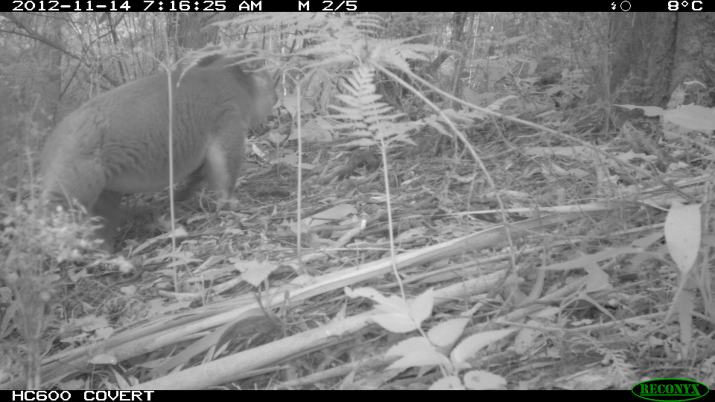
We have had what we hope is the first of many Koala’s detected by our remote cameras. This one was on the move past our camera site in the Tarra Valley. Koala sightings seem to be reported more frequently in the park in recent years, but this is only anecdotal as no proper ongoing survey has ever taken place. Importantly the park is part of the habitat of the Strzelecki Koala population, which is significant because the local Koalas are thought to be the only population in the state that are not descended from a handful of trans-located Koalas from French Island and hence are thought to be much healthier and genetically resilient.
This Koala is the first one we have seen one via our Remote Camera monitoring program.
This Koala was in an area of the Park that has some very large Mountain Grey-gum trees, (Eucalyptus cypellocarpa) which researchers believe is one of the local Koalas’ favourite food sources. Although not their first choice Mountain Ash (Eucalyptus regnans); which is the most common eucalypt within the park is thought to also be utilisted by Koalas as well as Messmate (Eucalyptus obliqua) which is also quite common. We would love to hear about any sightings in the park to add to our knowledge and to help contribute to regional efforts that are being made to get a better understanding about the distribution of the Strzelecki Koala and its health and well being.
Tonight’s the Friends of Tarra Bulga National Park committee had one of their regular meetings. It is always interesting to make the evening trip up to Balook, as you are almost guaranteed to see an interesting array of wildlife along the way. Tonight was no exception on the way up in the last hour of daylight there were plenty of wallabies darting out in front of the car and a couple of lyrebirds doing their last rounds of the day.
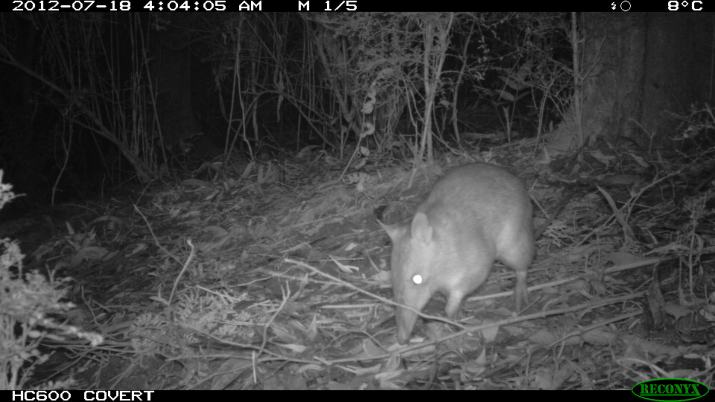
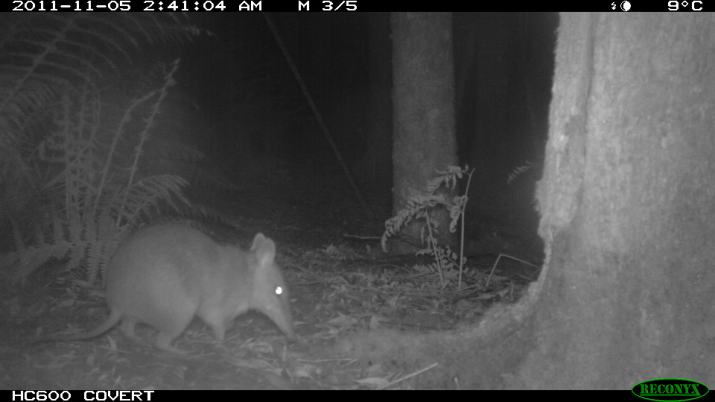
Long- nosed Bandicoot – Perameles nasuta
After the meeting it was now a couple of hours since dusk, back in the car and around the first few bends we catch some eye shine and a shape at the side of the road, slowing down it becomes clear that it is a fox with something in its mouth. With light from the headlights and the full moon, I can see a short tail and on the other side of the foxes snout a long pointy nose, unmistakably a bandicoot, bit sad that my first live sighting of a bandicoot at Tarra Bulga had to be this way. The full moon seems to get the fauna out and about and a little further on we stop the car when we spot a brush-tailed possum on the roadside. With the car stationary it strides across, with a tiny offspring hanging tenaciously on to its mother’s back. Next sighting is a couple of rabbits, which surely would have been our preferred option for the fox to be dining on.
Before the friends started monitoring with remote cameras, there had been no official records of bandicoots in the park for at least a decade (wildlife surveys can be an expensive business). What impacts do fox numbers have on bandicoot or lyrebird populations or even rabbits? How common are other feral animals in the park and what impact could they be having e.g. cats? What else is out there that we don’t know about (Could there be any Tiger Quoll? We could guess but without some means of surveying we wouldn’t really know. The Friends of Tarra Bulga now have a network of remote cameras across the park, we aim to use them to the best of our ability to get a much greater understanding of what is happening out there with all them critters.
A very common site in the Strzelecki Ranges, the Common Wombat – (Vombatus ursinus) is mostly nocturnal and shelters in large burrows. The single young leave the pouch around 6-9 months of age and follow the mother on foot until they are fully weaned at about 20 months old. They only produce one young every 2 years. They feed on grasses, sedges and tubers. Be on the look out for them on the roads at night, They have absolutely no road sense and are likely to run straight in front of your vehicle if startled.
This presence of this Long Nosed Bandicoot ( Perameles nasuta ) is one of the many insights we are gaining about the habits of the Fauna of Tarra Bulga with the use of our remote infrared cameras. Long-nosed Bandicoots are active from dusk to dawn, digging cone-shaped holes in their search for insects, fungi and fleshy plant roots (tubers).


 Friends of Tarra-Bulga National Park