Technology today has made it super-easy to dig up fascinating old newspaper articles like this one below from the Argus in 1925. We would have to think that the author would be fairly astounded if they could step forward in time and visit the Tarra-Bulga today. What will it be like 88 years from now??
THE TARRA VALLEY.
When in 1840 Strzelecki led an expedition from New South Wales over Mount Kosciusko and through Gippsland to Corinella, on Westernport Bay one of the party was an Australian aborigine named Charley Tarra. The choice of this native was fortunate for in the latter part of the journey when food supplies were exhausted it was Charley Tarra’s prowess as a hunter that saved the party from starvation.
To such straits were they reduced to in the last 50 miles – and so wild and rough was the country that it took them 22 days to hew their way through the bush – that they lived almost wholly on the flesh of Koalas or native bears. A few months later when a party from Melbourne chartered a vessel to carry them to the newly discovered province, they took with them Charley Tarra, and when they, or rather some of them were cutting their through the tangled way undergrowth back towards Westernport Tarra’s gun frequently provided the hungry travelers with bear flesh. Which if not tasty, at any rate had food value, It was therefore fitting that Tarra’s name should be preserved in the nomenclature of the streams of Gippsland and, on a river rising in the hills 10 0r 12 miles from where the town of Yarram has since been built, and flowing through a wilderness of bush and fern trees, was bestowed the name of Tarra. It is not an imposing stream, and along most of its course the beautiful surroundings have vanished.
Making a Hill Road (Source: Monash University Centre for Gippsland Studies)
As one wanders in South Gippsland with its hundreds of bare hills or if not bare then covered only with dead eucalypts, or through the lower lands that have nearly all been devastated by fire, it is difficult to picture what this great territory was like when it was first explored, or even to visualise it as it was half a century ago. But a page or two of “the universal and public manuscript” that at one time was expanded to the eye of all can still be seen in the upper part of the valley through which the Tarra River flows. They are not unsullied pages, for every here and there one comes on patches of dead trees looking like phantoms of the surrounding living giants, with their marble like boles. On the hills and in the valleys, the fern trees rise above a tangled wilderness of blanket-wood, hazel, and other scrubs peculiar to the virgin mountain forests of Victoria. Far down in the main valley and in the trackless ways of the Tarra’s gully tributaries are bowers of myrtles of various sizes and conditions, some lithe and fresh others old and hung with lichens. Along the road over the hill big hearted settlers, in spite of great difficulties and discouragement, have built homes and cultivated little clearings.
Hill farm in the Tarra Valley – (Source: Monash Uni Gipps Studies)
In some cases, however, the odds have proved too tremendous, and scrub and bracken are almost hiding from view the abandoned homesteads. Near the top of the range where the Tarra River has its source is a timber mill, and though all the machinery is still there it seems a long while since the mill was in operation Scores of white logs mark an old timber trail now partly over grown with young scrub, and the bush is gradually creeping back around the mill and the timber-getters’ huts.
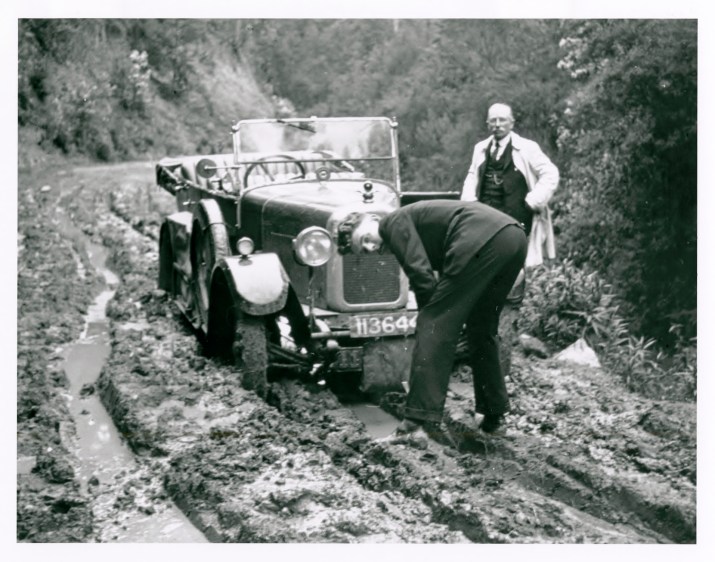
Car at Tarra Valley – Source: Monash Gipps Studies.
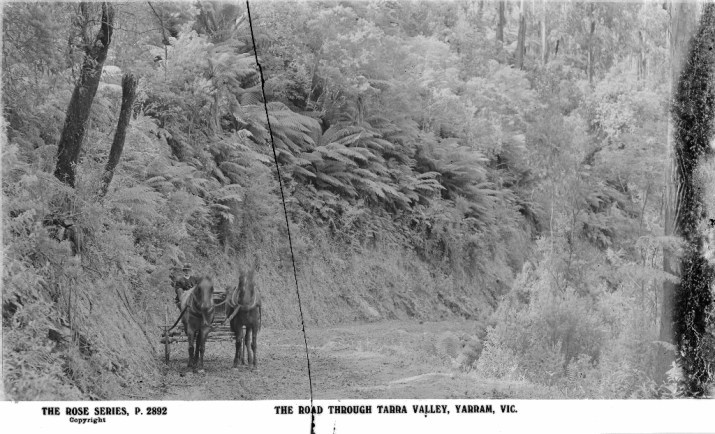
Near its source the scenery of the Tarra River is not surpassed by the beauty of any other valley in the State, but it is not likely to attract tourists. For the greater part of the year the road through it is almost impossible for motors, and there is too much stale, flat, and unprofitable country to be gone through to make the trip suitable for a walking tour. The bit of wild bush that is left is but a scrap of a mighty forest that 50 years ago covered South Gippsland, and this probably must ere long be destroyed and the name of the Tarra Valley be recorded only in the catalogue of things that were and cannot be again.
The Road Through Tarra Valley (Source: State Library of Victoria)
Dr Kath Handasyde is a senior lecturer in the Department of Zoology at the University of Melbourne and has been conducting research on koalas for over 30 years. She is coming down to Tarra Bulga National Park on Saturday October the 26th to share Koala knowledge with us. The day will begin with a free BBQ lunch at the visitors centre, then we will head down and go for a walk around a new track in the Tarra Valley, to see what we can find. Please note the walk does include some steep and slightly challenging terrain so people need to come prepared with suitable footwear, it will take about 2 hours. Everyone is welcome but please RSVP to Pam on 5196 6140 or Peter 0447 474 573 by Friday October the 18th for catering purposes.
Male Koala recorded by our new machine. Just went out into the field to collect the first set of recording from our new (replacement) Songmeter automatic recording device. The first file I had a look was from 10.30pm one night and it started of with a very nice Boobook Owl call. A few minutes later this scary monster started up, this is the third location in the park were we have recorded one of these lately.
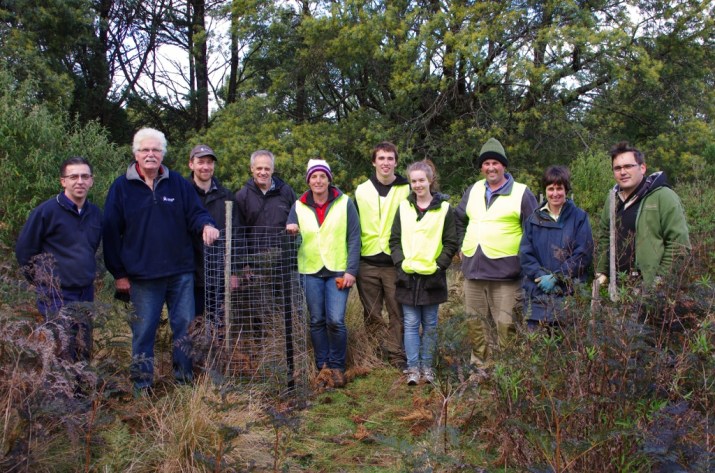
Friends of Tarra Bulga recently held its AGM, where the diverse activities carried out by the group were highlighted. A major activity of the group is to staff the Parks Visitor’s centre, in the past year 29 Volunteers contributed to opening the centre on Weekends and School and Public Holidays (a total of 182 days).
The Friends also have plenty of hands on activities throughout the year aimed at helping to learn more about the park and enhance it. This includes walks along some of the more remote tracks, Lyrebird surveys and working bees involving both weed control and tree planting. The group undertakes photo-monitoring of various sites to monitor vegetation change and has a network of remote cameras that are helping to gain a better picture of what is happening with both native and feral animals in the park. A device that can be left out in the park to record frog, bird and bat calls is a recent acquisition.
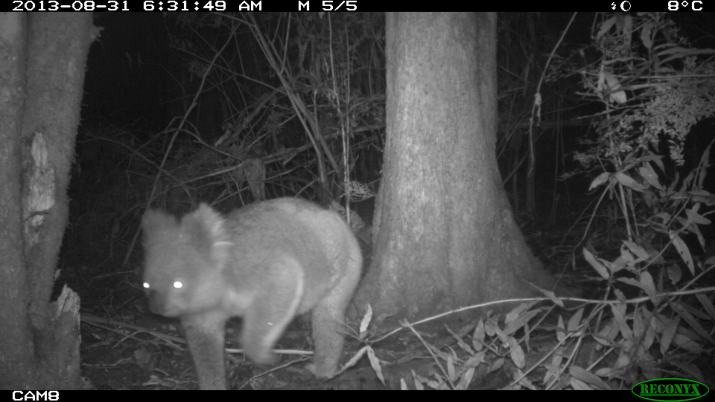
Example of what can be found on the remote cameras.
To let everyone know what is happening in Tarra Bulga and more about its plants animals and fungi they have a Blog http://www.tarrabulga.wordpress.com which is packed full of photos and information. They are also on Facebook and Twitter and are very keen for the public to share their own Tarra Bulga experience via these sites. You can also find more information about getting involved with the group by contacting the Ranger, Craig Campbell on 5172-2508.
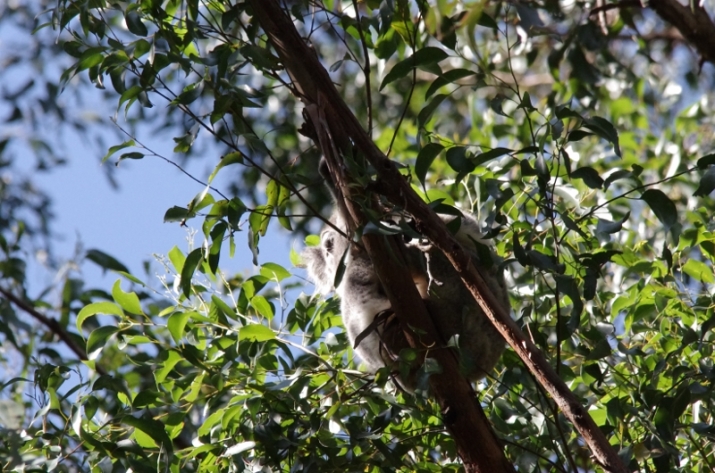
Since our remote camera project began around two years ago, we had only once photographed a Koala. These figures have now been boosted by 800% with a camera in the north east of Tarra Bulga National Park capturing a Koala eight times all on separate days over a period of about 7 weeks. Most sightings were in the early morning, but a few were in the evening. Another case luck with the camera being at the right place at the right time to film the comings and goings of the locals.
It is a perfect time to visit Tarra Bulga at present because #spring flowers are currently at their peak. The photo gallery attached shows some of the species that are out in Flower at present, get up their and have a look and see what you can find. If you get any good shots please share them with us via our Facebook Page or this Blog.
After seeing an interesting looking old tree, with some interesting looking hollows, which was leaning over on an angle, we thought it might worth trying something a bit different and pointing a remote camera at it. Not expecting much of a result, it was great to find that it is a busy spot for some of our small mammal species. Antechinus, Bush Rats, Brushtail and Ringtail Possums were all regular users. It was very exciting to also photograph some Sugar Glider activity, this is the first time we have managed to get a shot of one with our cameras.




 Friends of Tarra-Bulga National Park