Strzelecki Koala

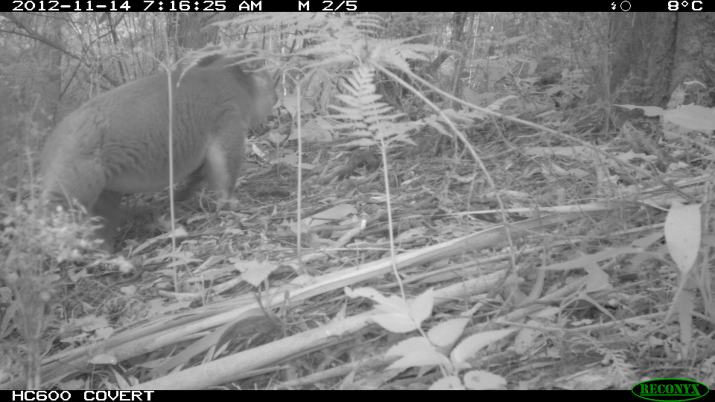
We have had what we hope is the first of many Koala’s detected by our remote cameras. This one was on the  move past our camera site in the Tarra Valley. Koala sightings seem to be reported more frequently in the park in recent years, but this is only anecdotal as no proper ongoing survey has ever taken place. Importantly the park is part of the habitat of the Strzelecki Koala population, which is significant because the local Koalas are thought to be the only population in the state that are not descended from a handful of trans-located  Koalas from French Island and hence are thought to be much healthier and genetically resilient.

Koala at Tarra Bulga
This Koala is the first one we have seen one via our Remote Camera monitoring program.

This Koala was in an area of the Park that has some very large Mountain Grey-gum trees, (Eucalyptus cypellocarpa) which researchers believe is one of the local Koalas’ favourite food sources. Although not their first choice Mountain Ash (Eucalyptus regnans); which is the most common eucalypt within the park is thought to also be utilisted by Koalas as well as Messmate (Eucalyptus obliqua) which is also quite common. We would love to hear about any sightings in the park to add to our knowledge and to help contribute to regional efforts that are being made to get a better understanding about the distribution of the Strzelecki Koala and its health and well being.

Olearias

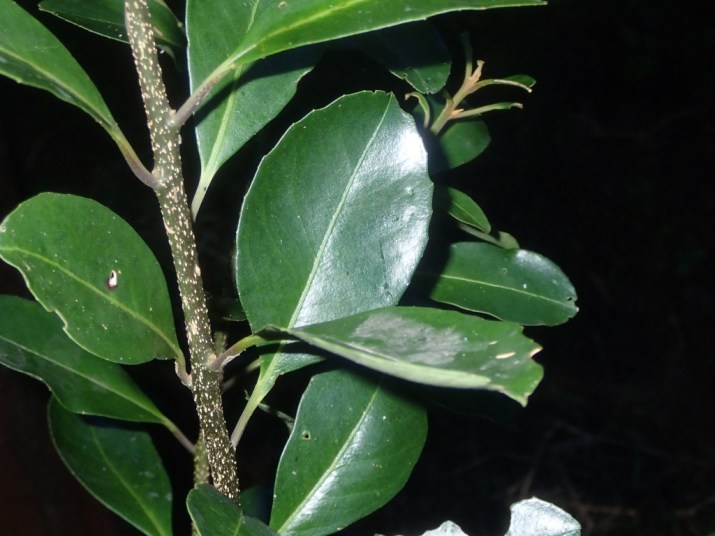
Tarra Bulga National Park has three different species of Olearia which are members of the daisy family. Two of them can be a little tricky to tell apart, however one is clearly different to the others. From casual observation all of them have similar looking flowers and the best way to tell them apart is by examining the leaves.

Olearia lirata – (Snowy daisy-bush) is a very common species in the park, although it is not usually present in the rainforest gullies; it is a dominant shrub in the wet sclerophyll forest areas (which is the most common vegetation type in the park). It is a small to medium sized shrub and its medium sized leaves are lance shaped and usually green and shiny above and grey and hairy underneath.

Olearia phlogopappa – (Dusty daisy-bush) is less common in the park than Olearia lirata and is  and mostly found in the more disturbed areas; it is also a small to medium sized shrub. It has narrower leaves, that are more greyish and not shiny (hence dusty) with tiny hairs on the underside. The leaves also usually have blunt teeth along their margins.

Olearia argophylla – (Musk daisy-bush)is the third species. It is a large shrub almost to the size of a small tree. Its leaves are much broader and larger than the other two species, they are green on the top and whitish or silvery underneath. It can occur in all forest types within Tarra Bulga, including the rainforest gullies.

Related Posts

Local Cassinias

This is the time of year when most of the daisy species in Tarra Bulga are in flower. A number of species look quite similar and a bit of knowledge is often needed to tell one from another.They are all medium shrubs with narrow linear leaves and similar looking cauliflower like flower-heads.

One group are the Cassinias’ there are three separate species and all of them occur in the more open and exposed sections of the park rather in the shaded and protected gullies

Cassinia aculeata – (Common Cassina or Dogwood) has the the shortest and narrowest leaves of the three. If you look underneath the leaves you can see that they are curled over at the edges. Another distinguishing feature is that the new flowers are sometimes pink rather that white.

Cassinia longifolia – (Shiny Cassinia) has broader and longer leaves and the new leaves are noticeably shiny and sticky to touch. The underside of the leaves are covered in short dense hairs and the vein down the middle is very prominent.

Cassinia trinerva – (Three-veined Cassinia)Has leaves that are also broader and longer than Common Cassina, they are quite soft and not shiny or sticky. They have a big vein running down the middle of the leaf and two smaller veins that run a millimetre or two inside the leaf margins.

Ozothamnus ferrugineus (Tree Everlasting) is a fourth species that can be confused with the Cassinia’s as it is a similar size and has similar leaves. It’s leaves are around the same size as Cassinia longifolia (Shiny Cassinia) but its leaf margins are usually a little wavy. With close examination the flowers are clearly different to Cassinias, they have little bracts around the individual florets.

Wild Cherry Track and Macks Creek Warm Temperate Rainforest Walk

The Friends of Tarra Bulga are holding another activity on Saturday November the 17th which is designed to give people the opportunity to explore some of the less visited and remote sections of the Park. People should meet at the Visitors Centre at 9.30 am where a car shuffle will be organised.

Exocarpos cupressiformis - Cherry Ballart
Wild Cherry Track – Tarra Bulga National Park, Showing a patch of the species it was named after: (Exocarpos cupressiformis – Cherry Ballart)

The walk will include the Wild Cherry Track which is named for the native Cherry Ballart trees, (Exocarpos cupressiformis) which occur along one section of it and then leave the park boundary and proceed along a section of the new Grand Strzelecki Walking Track where it follows Macks Creek including Warm Temperate Rainforest that has been the target of restoration activities over the last few year. HVP’s Richard Appleton will be coming along to share his knowledge about this intriguing area.

Although the walk has been designed (with the help of the car shuffle) to be mainly down hill it is very steep in sections and will also be slippery in spots. A bit of rock hopping will also be required to get over Macks Creek so all participants need to be reasonably mobile. You will also need to BYO lunch and drink. Please contact Peter Bryant on 0447474573 to to register for this walk by Thursday 15th of November so we can organise the car pool arrangements.

Myrsine howittiana - Muttonwood
Myrsine howittiana – Muttonwood is one of the canopy species found in the Warm Temperate Rainforest community along Macks Creek.

Clematis Season

There are two species of Clematis that occur in Tarra Bulga National Park and surrounding forest areas, Forest Clematis (Clematis glycinoides) and Mountain Clematis (Clematis aristata) and it can be very difficult to tell the difference between them. They are climbing plants that can climb high into trees and produce a mass of attractive white flowers in Spring. Both of them have leaves in groups of three of a similar size, Clematis aristata commonly has teeth or serrations on the leaf margins but both species show variation.

Clematis leaf comparison

There are two main ways to tell the difference between the two out in the field. The first is flowering time. Clematis glycinoides tends to flower in early spring, with most of its flowering finished by mid-October, then Clematis aristata seems to take over to be the dominant flowering species for a month or so, although locally it is less common. The other way is a key but subtle difference in the flowers. If you look carefully at a flower the tips of the anthers have little appendages, In Clematis glycinoides they are very short <1mm or even absent. In Clematis aristata they are clearly longer usually around 2 or 3mm long.

Clematis Flowers
Clematis glycinoides (Forest Clematis) and Clematis aristata (Mountain Clematis) flowers compared.

What are we monitoring for?

Tonight’s the Friends of Tarra Bulga National Park committee had one of their regular meetings. It is always interesting to make the evening trip up to Balook, as you are almost guaranteed to see an interesting array of wildlife along the way. Tonight was no exception on the way up in the last hour of daylight there were plenty of wallabies darting out in front of the car and a couple of lyrebirds  doing their last rounds of the day.

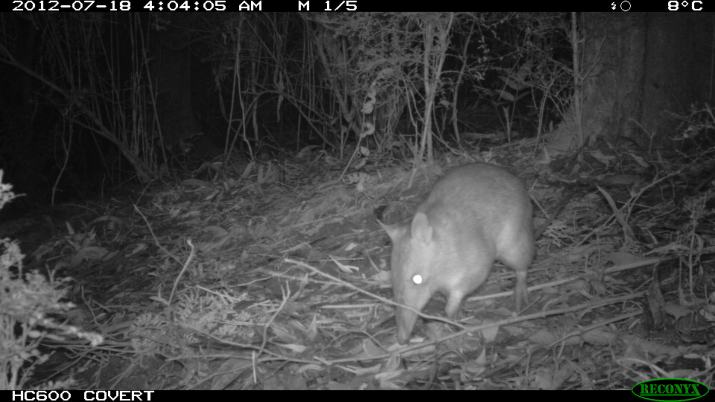
Long- nosed Bandicoot - Perameles nasuta
Long- nosed Bandicoot – Perameles nasuta

After the meeting it was now a couple of hours since dusk, back in the car and around the first few bends we catch some eye shine and a shape at the side of the road, slowing down it becomes clear that it is a fox with something in its mouth. With light from the headlights and the full moon, I can see a short tail and on the other side of the foxes snout a long pointy nose, unmistakably a bandicoot, bit sad that my first live sighting of a bandicoot at Tarra Bulga had to be this way. The full moon seems to get the fauna out and about and a little further on we stop the car when we spot a brush-tailed possum on the roadside. With the car stationary it strides across, with a tiny offspring hanging tenaciously on to its mother’s back. Next sighting is a couple of rabbits, which surely would have been our preferred option for the fox to be dining on.

Before the friends started monitoring with remote cameras, there had been no official records of bandicoots in the park for at least a decade (wildlife surveys can be an expensive business). What impacts do fox numbers have on bandicoot or lyrebird populations or even rabbits? How common are other feral animals in the park and what impact could they be having e.g. cats? What else is out there that we don’t know about (Could there be any Tiger Quoll?  We could guess but without some means of surveying we wouldn’t really know. The Friends of Tarra Bulga now have a network of remote cameras across the park, we aim to use them to the best of our ability to get a much greater understanding of what is happening out there with all them critters.

Sycamore Maple Revegetation Site

Made the trek out to the re-vegetation site for the first time since the planting was done which was a bit over two months ago.

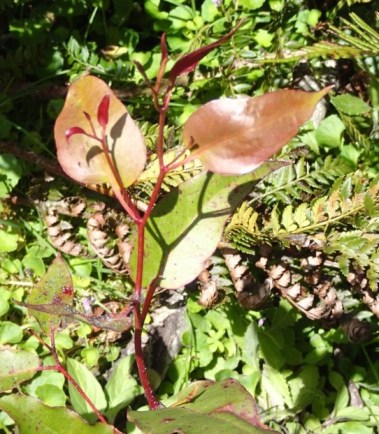
Fresh New Growth on Mountain Ash Seedling

From looking around the site there was both good and bad news. First the good, there was virtually no sign of any Wallabies managing to get to chew any of the new seedlings, despite the fact I heard one hopping away when I reached the site. There was good fresh new growth on all the seedlings that I found, hopefully when they become more conspicuous as they get taller the wallabies will still find them too difficult to reach. The bad news is that after seeing very, few new seedlings of Sycamore Maple