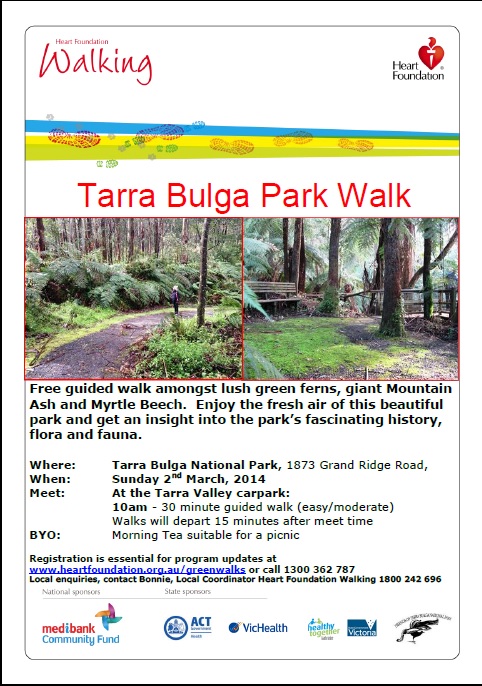
Its Parks Week next week and the Heart Foundation are running two guided walks , first one is this Sunday March the 2nd and it will be at the Tarra Valley at 10am.
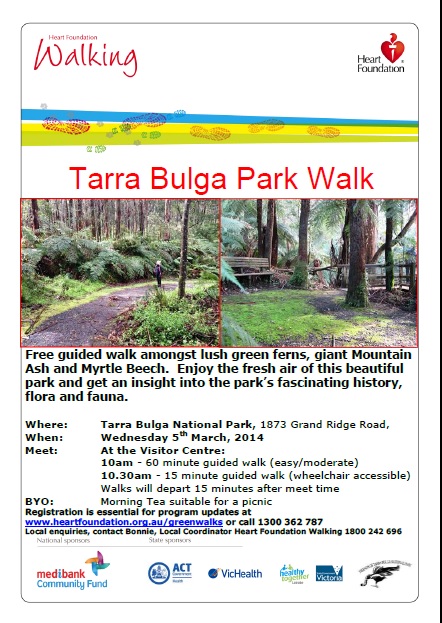
Next one will be around the Bulga Park area and is on Wednesday (March the 5th).
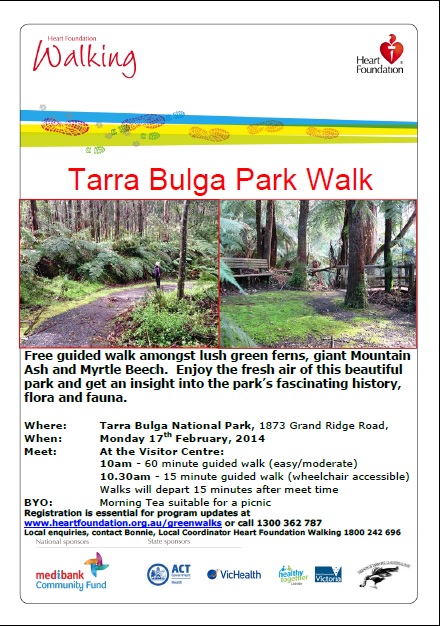
First in a series of “Green Walks” in Tarra Bulga coming up on Monday Feb the 17th. Friends of Tarra Bulga are helping out as guides, so anyone in the Friends Group that wants to come out is more than welcome (as are all members of the public who will need to register here) http://www.heartfoundation.org.au/active-living/walking/Pages/events-and-park-walks.aspx or phone 1300 362 787
The recent news involving a Sea Eagle flying off with a remote camera in the Kimberley has inspired us to put together this video of a Superb Lyrebird, that seemed to think the reflection in the front of the camera was a rival and hence went to war. This happened in September 2012 and thankfully we have not had a repeat. However we did stop putting cameras quite so close to the ground.
Had a small group for our most recent event on Saturday the Duff/Trail Mt Tassie Walk. The weather held off despite the bad forecast and we saw that walking this section of the Grand Strzelecki Track is another way to see some great local Landscapes not just confined to Tarra-Bulga National Park.
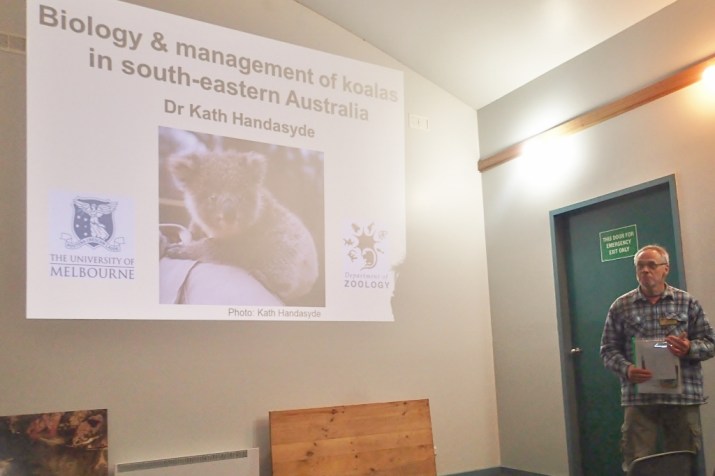
The Friends of Tarra Bulga hosted a very interesting and enjoyable day on Saturday when we welcomed a guest Dr. Kath Handasyde, who is a Senior Lecturer at Melbourne University and specialises in wildlife ecology, management and diseases. Starting with a yummy BBQ lunch we then proceeded into the visitors centre where Kath gave a fantastic insight into the management of Koala populations in South Eastern Australia.
Talk in the visitors centre
The major issues facing Victorian Koalas is overpopulation, this problem occurs mainly on island locations or in mainland areas where there were trans-locations or re-introductions into areas with isolated or fragmented habitat. In extreme cases in these locations habitat trees are being completely denuded with catastrophic consequences for not only the Koalas but for the whole ecology of these places. Kath outlined the success researchers have had in developing slow release hormonal implants that have been a successful contraceptive for females; it seems like where they have been applied to a sufficient percentage of the population that there has been some success in maintaining more sustainable Koala populations. Management of these crowded populations however is a very intensive process and while the contraceptive implants, make the process more efficient, it is a struggle to have enough management resources to keep up with the areas in crisis (e.g. Cape Otway).
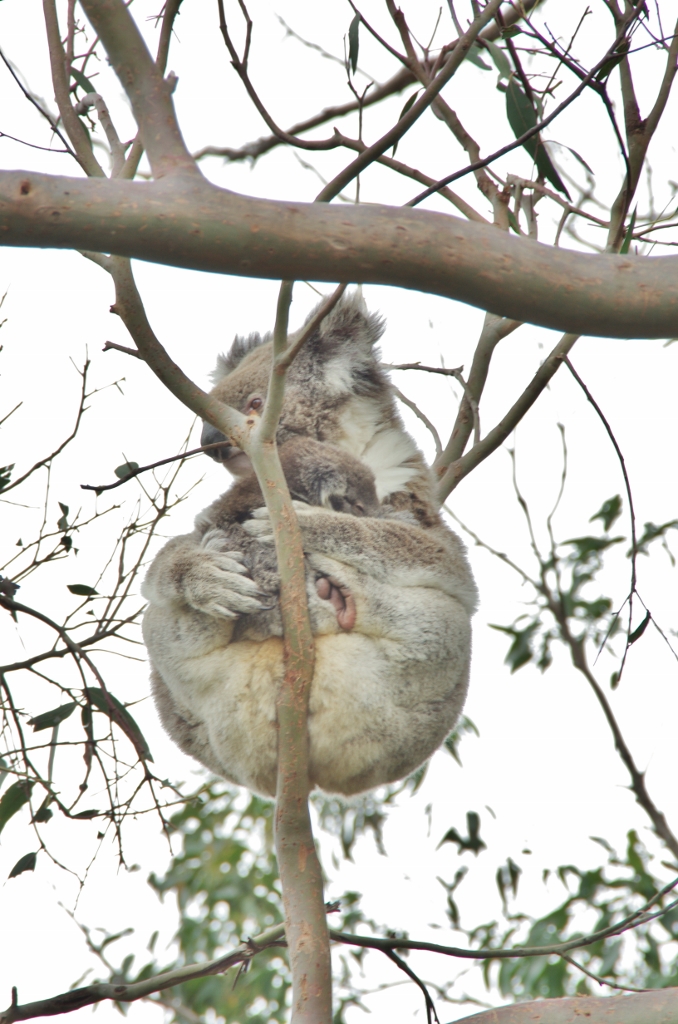
Koala mother in a defoliated tree in at Cape Otway
It seems locally that we are lucky that our local Koala populations are not having over-population issues. We have a relatively low density of Koalas, thought to be because of the higher altitudes and cooler temperatures making it harder for Koalas (who can’t shelter in tree hollows like many other species) to consume enough energy to meet their needs. This probably means the local ones have a shorter life-span (a limiting factor on a Koala’s life is their teeth, when they have worn out they can no longer process enough food).
The quality of the local food is also thought to be a factor that controls the population. Manna Gums are not widespread and they rely mainly locally on species such as Mountain Grey Gum which possibly don’t have the same nutritional value. In the local region there are also fairly good linkages between habitat areas, meaning that populations can disperse successfully if crowding becomes an issue in one site. In some areas habitat linkages are mainly along roadside vegetation, meaning road deaths are common. The local population is also though to have greater genetic diversity than the rest of the state, so this should mean the population has greater resilience, although the animals in the rest of the state are still generally very hardy robust animals. Our monitoring program will also help to keep tabs on any changes in the local Koala population levels.
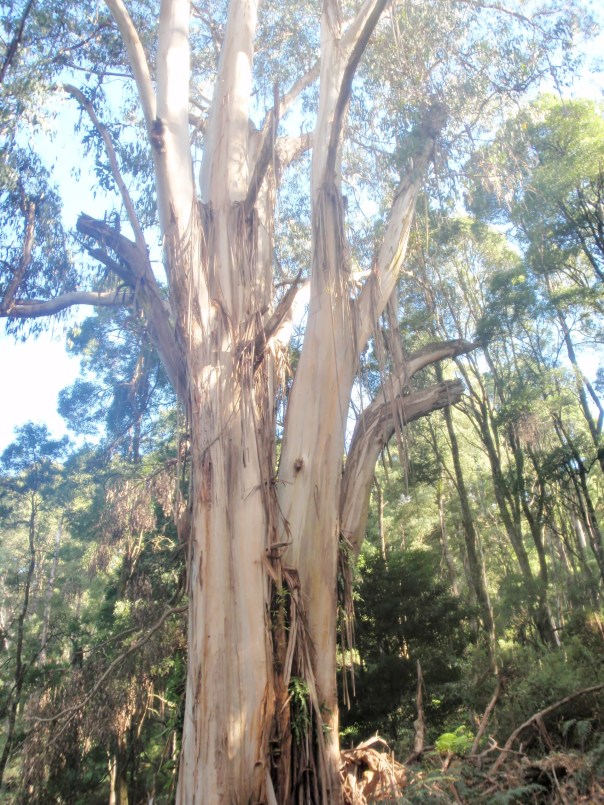
Local Koala Food Tree – Mountain Grey Gum
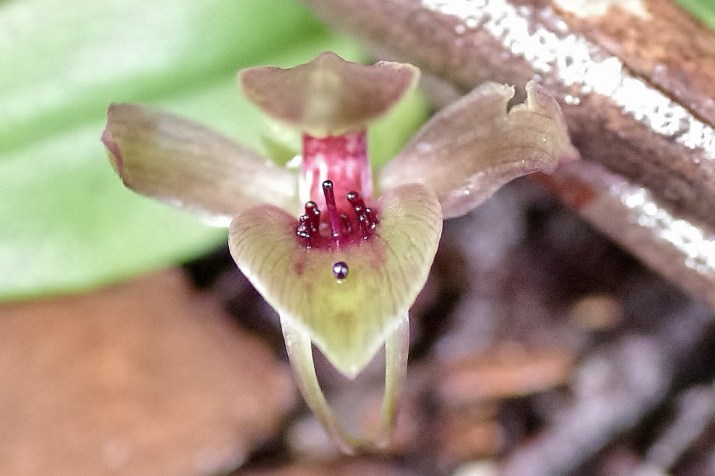
After the talks some of us headed out in convoy to the Tarra Falls car park and then did a loop walk starting by going up Diaper TK. At the start of the walk we unfortunately copped an instant onslaught of Leeches, but that was offset by the scenery and the two species of Bird Orchid in flower in the middle of the track. Kath used her all her spotting senses to discover some Koala droppings (Scats), but we did not get a live sighting today; not that surprising given that spotting is quite difficult given the tall towering trees and healthy canopy that make up the local habitat as well as the fact that we don’t have a high population density. All in all it was a great day, and a big thanks has to go out to Kath who made the big effort to come down here and share her extensive knowledge.
Since our remote camera project began around two years ago, we had only once photographed a Koala. These figures have now been boosted by 800% with a camera in the north east of Tarra Bulga National Park capturing a Koala eight times all on separate days over a period of about 7 weeks. Most sightings were in the early morning, but a few were in the evening. Another case luck with the camera being at the right place at the right time to film the comings and goings of the locals.
After seeing an interesting looking old tree, with some interesting looking hollows, which was leaning over on an angle, we thought it might worth trying something a bit different and pointing a remote camera at it. Not expecting much of a result, it was great to find that it is a busy spot for some of our small mammal species. Antechinus, Bush Rats, Brushtail and Ringtail Possums were all regular users. It was very exciting to also photograph some Sugar Glider activity, this is the first time we have managed to get a shot of one with our cameras.




 Friends of Tarra-Bulga National Park